











-


Upholding commitments, speaking truthfully, acting with determination.
Maintaining integrity and self-discipline, and ensuring transparency.

-
Anti-Bribery Compliance Statement
-
How to use the manual
-
Basic principles of anti-bribery
-
Overview
-
Introduction to anti-bribery in countries around the world
-
Common types of bribery
-
Anti-bribery practice guidelines
-
Anti-Bribery Management System
Anti-Bribery Compliance Manual
-
Published Date:2025-07-17
-
Anti-Bribery Compliance
-
Page Views:1292
-
Anti-Bribery Compliance Statement
Zhejiang Huayou Cobalt Co., Ltd (hereinafter referred to as "Huayou Cobalt") is committed to becoming a global leader in the new energy lithium-ion materials industry. To achieve this goal, we continuously advance international development, provide high-quality products, uphold a strong business reputation, and maintain robust competitiveness, securing a leading position in a fair, open, and orderly market environment.Simultaneously, Huayou Cobalt remains steadfastly dedicated to rejecting any form of bribery or corrupt practices. We firmly believe that an image of integrity and ethical conduct is crucial for maintaining our industry leadership and strong reputation, and serves as the key foundation for earning the long-term trust of customers and business partners.
Bribery, a prevalent form of unfair competition in market economies, violates the requirement for fair competition, disrupts transactional order, and undermines the fundamental principles of honesty and credibility in commerce. Such misconduct exposes companies to significant financial and reputational risks.Therefore, Huayou Cobalt adopts a strict zero-tolerance policy toward all forms of bribery and corruption. We neither engage in nor condone such practices. Our anti-bribery and anti-corruption policies fully comply with all applicable laws and regulations in China and every country where we operate.
Zhejiang Huayou Cobalt Co., Ltd
November 2, 2023
-
How to use the manual
In order to guarantee that the Company conducts its business in compliance with the law and improve its compliance management level in accordance with the law, according to the Criminal Law of the People's Republic of China (hereinafter referred to as the "Criminal Law"), the Law of the People's Republic of China Against Unfair Competition (hereinafter referred to as the "Anti-Unfair Competition Law") ") and other domestic laws and regulations, the regulations on anti-bribery in the countries where the business is located, the World Bank's Guidelines on Preventing and Combating Corruption in IBRD Loans and IDA Credits and Grant-Financed Projects (hereinafter referred to as the "WB's Anti-Corruption Guidelines"), ISO37001:2016 "Anti-Bribery Management System Requirements and Guidelines for Use" issued by the International Organization for Standardization, and other relevant anti-bribery and anti-foreign corruption regulations of overseas countries and international organizations, we have sorted out and refined the basic requirements for anti-bribery and anti-foreign corruption compliance, and the Company establishes, implements, maintains and continually improves the anti-bribery management system in accordance with the requirements of the laws, regulations and standards, including the required processes and their interactions.
This manual aims to provide clear guidance for all employees to understand bribery-related concepts, identify various manifestations of bribery, and recognize associated compliance risks. All employees must thoroughly study, comprehend, and apply this manual in business operations while gaining awareness of relevant anti-bribery laws and regulations and developing the ability to detect compliance risks. When engaging in market activities or managing relationships with clients, business partners, or government regulators, employees shall effectively identify forms and risks of bribery in accordance with this manual and strictly avoid prohibited conduct outlined herein.
-
1 Basic principles of anti-bribery
1.1The "zero tolerance" principle
Bribery of any kind is prohibited and no support of any kind, financial or non-financial, is provided for bribery.
1.2 Principle of legality
Comply with the requirements of anti-corruption and anti-bribery laws and regulations and other normative documents of China, host countries and international organizations.
1.3 Compliance Priority Principle
When conflicts arise between business interests and compliance requirements, adherence to compliance obligations prevails over commercial gains; nor shall any employee be penalized for diminished business gains resulting from compliance with anti-bribery requirements.
1.4 Principle of comprehensiveness
Anti-bribery compliance management should cover all business areas, departments and subsidiaries at all levels.
-
2 Overview
2.1 Concept of bribery
Bribery is defined as the direct or indirect offering, promising, giving, accepting, or soliciting of any undue advantage in violation of applicable laws, at any location, to induce or reward an individual for the improper performance of any act or omission in connection with their official capacity.
The Criminal Law of the People's Republic of China, Anti-Unfair Competition Law of the People's Republic of China, Council of Europe Criminal Law Convention on Corruption, U.S. Foreign Corrupt Practices Act (FCPA), UK Bribery Act 2010, Indonesian Anti-Bribery Law, Indonesian Corruption Eradication Law, National Anti-Corruption Strategy of the Democratic Republic of the Congo, United Nations Convention Against Corruption, and other statutory instruments across jurisdictions explicitly prohibit bribery while establishing corresponding regulatory measures and penalties.
A comparative review of anti-bribery legislation across jurisdictions and international organizations demonstrates that while manifestations of bribery differ, their core concept remains fundamentally aligned: all forms essentially involve providing financial or other advantages to transaction counterparts or relevant third parties potentially influencing transactions, aiming to secure unfair competitive advantages.
Common means of bribery or improper benefits offered include providing monetary assets, material goods, and other advantages.
(ⅰ) Means of providing monetary benefits may include: gifts, loans, fees, compensation, kickbacks, promotional expenses, advertising fees, commercial sponsorship funds, research grants, service charges, consulting fees, commissions, facilitation payments, etc;
(ⅱ) Possible ways of providing in-kind goods: antiques, paintings and drawings of famous people, electrical goods, automobiles, gold, silver or other precious metal products, etc;
(ⅲ) Possible ways to provide other benefits: Ostensible professional activities such as domestic or international training programs, inspections, tourism, dining, and entertainment hospitality—alongside abuse of official positions or exploitation of personal connections to resolve personal matters including but not limited to school admissions, employment, housing allocations, or household registration issues for counterparts or their families.
2.2 Distinction between bribery and normal commercial transactions
In business operations, compliant payment of commissions and provision of discounts can easily be confused with illegal bribery. The key criterion for determining whether such payments or benefits carry bribery risks is whether they are explicitly disclosed and properly recorded in the accounts. If the amount and method of payment for such commissions or discounts are clearly stipulated in contracts or other written agreements, and accurately recorded under the correct accounting categories in lawful financial books in compliance with accounting standards, the risks of indirect bribery or illegal kickbacks can be effectively mitigated. Conversely, failure to record, maintaining false accounts, or misclassifying such expenses in financial records will expose the company to significant bribery risks.
Key distinguishing criteria between legitimate business engagements/customary courtesies (gifts, hospitality) and bribery include the following dimensions:
(ⅰ) Whether the value of gifts or hospitality expenses substantially exceeds prevailing standards for legitimate business engagements and customary courtesies in the given context;
(ⅱ) The purpose, timing, and method of gift exchanges or hospitality provisions and critically, whether the provider is seeking official favors from the recipient;
(ⅲ) Whether the recipient leverages their official capacity or influence to seek improper advantages on behalf of the provider.
2.3 Bribery and corruption of employees and the application of the law
All employees shall comply with anti-bribery and anti-corruption regulatory instruments,including laws and regulations of China, host countries, and international treaties/rules, to prevent corrupt practices domestically or abroad. Where any employee's bribery or corruption infringes upon the company's legally protected interests, the company reserves the right to pursue civil liability against such individuals under applicable Chinese or host country legislation.
Should bribery misconduct be identified in business activities during internal investigations, all employees must actively cooperate with the inquiry by promptly providing relevant information—including but not limited to call records, WeChat communications, transaction documentation, and other evidentiary materials,to ensure unimpeded conduct of corporate investigations.
-
3 Introduction to anti-bribery in countries around the world
The promulgation of international anti-bribery frameworks exemplified by the UN Convention Against Corruption, alongside continuous refinement of anti-corruption legislation in major jurisdictions, reflects a fundamental global consensus on regulating and combating bribery. While conceptual alignment exists across leading national and international regulations regarding bribery's definition and governance, substantive variations emerge in legislative implementation and enforcement practices. This chapter delineates the anti-bribery regimes of the United Nations, China, the United States, European Union, Indonesia, Democratic Republic of the Congo, and World Bank Group to facilitate employee compliance reference, thereby promoting heightened risk awareness in domestic/overseas operations and advancing sustainable and sound business development.
3.1 United Nations Convention against Corruption
The United Nations Convention against Corruption (hereinafter "the Convention") stands as the pioneering international legal instrument against corruption and the most influential comprehensive global treaty centered on regulating bribery. Adopted by the 58th UN General Assembly at its 51st plenary meeting on 31 October 2003, the Convention emerged amid universal consensus within the international community regarding anti-corruption imperatives. The Convention establishes binding legislative frameworks for states, aiming to promote strengthened measures for preventing and combating corruption, enhanced international cooperation and technical assistance in anti-corruption efforts, and advocacy of integrity, accountability, and proper public affairs/asset management—demonstrating tangible impacts on signatory states' domestic legislation wherein: upon U.S. Senate ratification, it became constitutionally supreme federal law per Article VI of the U.S. Constitution; the UK Bribery Act 2010 implemented Convention-mandated bribery offenses; France's Sapin II Law expanded "influence peddling" to judicial officials aligning with Convention Article 18; and China amended its Criminal Law to criminalize bribery of foreign public officials/international organization officers post-NPC ratification.
From the perspective of preventing the occurrence of acts prohibited by the convention in the course of business operations, we focus on the convention from the following aspects:
3.1.1 Scope of the subject of the bribe
The Convention adopts an expansive definition of bribery recipients, maximally broadening the scope of punishable subjects by encompassing: public officials, foreign public officials, officials of international public organizations, and any individual serving in any capacity as a leader of or employee within a private sector entity.
Public officials encompass individuals holding legislative, judicial, or administrative positions; any personnel performing public functions or providing public services for public agencies or public enterprises; and potentially include political party officials exercising public authority.
3.1.2 Elements of the bribery offence
Regarding the subjective element, establishing bribery offenses under the Convention requires the perpetrator's intentional state of mind—specifically, the corrupt intent to secure undue competitive advantages or benefits through the bribery act.
Regarding objective elements, the perpetrator must confer improper benefits upon the aforementioned bribery recipients, encompassing all tangible and intangible advantages—where, pursuant to Article 9 of the International Code of Conduct for Public Officials, any "gift or other benefit that may reasonably be deemed to influence the exercise of a public official's duties, functions, or judgment" constitutes such improper benefit. Prohibited modalities include both direct and indirect means, whereby any conferral of advantage—whether directly to recipients or indirectly through third-party channels—qualifies as bribery.
3.1.3 Implementation mechanisms
The Convention recommends that States Parties criminalize: concealment of illicit proceeds, unexplained wealth, trading in influence, embezzlement within the private sector, and private sector bribery. It further advises establishing corresponding judicial procedures and evidentiary rules under domestic law to implement remedial measures addressing corruption’s consequences—including victim compensation, seizure/freezing/confiscation of criminal proceeds and instrumentalities—while incentivizing cooperation between perpetrators and prosecutorial authorities. Simultaneously, the Convention mandates enhanced international cooperation against transnational crime, with Article 44 providing comprehensive provisions on extradition conditions/legal bases/procedural requirements/rights of extradited persons and special considerations. Regarding sentenced person transfers, States Parties may conclude bilateral agreements to repatriate corruption offenders sentenced to deprivation of liberty to their countries of nationality until sentence completion. The Convention meticulously regulates mutual legal assistance and joint investigations between States Parties, authorizing specialized investigative techniques such as controlled deliveries, electronic surveillance, and undercover operations.
3.2 China's anti-bribery legal system
3.2.1 Anti-Bribery Laws and Regulations
China's anti-bribery legislative framework primarily comprises the Criminal Law and Anti-Unfair Competition Law (AUCL). The AUCL's anti-bribery provisions target "business operators"—a broadly defined scope encompassing all commercial entities and individuals engaged in business activities. Crucially, the AUCL establishes a rebuttable presumption whereby employee bribery conducted to secure transactional opportunities or competitive advantages for their employer is attributable to the corporate entity, absent proof to the contrary, thereby substantially expanding the law's jurisdictional reach.
Bribery offenses are classified into three tiers based on severity: unfair trading practices, administrative violations, and criminal acts. Minor cases involving negligible amounts constitute unfair trading practices—violating business ethics and market rules—which shall be addressed per disciplinary guidelines of Party/state organs, sectoral regulators, and self-regulatory bodies. Cases with limited impact and moderate amounts qualify as administrative violations; though breaching the Anti-Unfair Competition Law and other regulations without meeting criminal thresholds, they incur administrative sanctions. Bribery involving substantial amounts or aggravated circumstances constitutes criminal acts subject to criminal penalties under the Criminal Law.
3.2.2 Investigation of law enforcement agencies
Enforcement jurisdiction over administrative bribery violations resides primarily with local market regulatory authorities. Where bribery constitutes suspected criminal conduct, judicial organs assume jurisdiction: The National Supervisory Commission investigates bribery offenses involving state functionaries, while public security organs handle cases concerning non-state actors. Following investigations establishing criminal liability, procuratorates initiate public prosecution before people's courts pursuant to statutory procedures.
3.2.3 Legal liability
3.2.3.1 Civil liability
Should a company engage in bribery despite having executed anti-bribery clauses or integrity commitments within partner agreements, such conduct shall constitute a material breach of contract, potentially resulting in contract rescission and liability for contractually stipulated liquidated damages, compensatory damages, and other remedies for contractual default.
3.2.3.2 Administrative liability
Article 19 of the Anti-Unfair Competition Law stipulates administrative liability for bribery: "Where business operators bribe others in violation of Article 7 hereof, the market regulatory authorities shall confiscate illegal gains and impose fines ranging from RMB 100,000 to RMB 3,000,000. In aggravated circumstances, business licenses shall be revoked."
3.2.3.3 Criminal liability
Bribery involving substantial amounts or aggravated circumstances shall incur criminal penalties under the Criminal Law, primarily governed by provisions on graft and bribery offenses. Perpetrators may face prosecution under eight distinct charges: Acceptance of Bribes;Offering Bribes; Unit Acceptance of Bribes; Unit Offering of Bribes; Bribing Non-State Functionaries; Non-State Functionary Bribery; Bribing Units; Bribery Intermediation. Conviction for these offenses carries maximum penalties of life imprisonment, criminal fines, and confiscation of property.
3.3 The United States legal regime against briber
3.3.1 Anti-Bribery Laws and Regulations
The United States enforces stringent anti-bribery and anti-foreign-corruption laws with extensive extraterritorial jurisdiction. Chief among these is the Foreign Corrupt Practices Act (hereinafter "FCPA") enacted in 1977, comprising anti-bribery provisions and accounting provisions. The anti-bribery provisions prohibit bribery of foreign officials, party officers, and other public agents to obtain/retain business or secure improper advantages. The accounting provisions mandate accurate record-keeping and maintenance of adequate internal controls by issuers registered with the U.S. Securities and Exchange Commission (SEC), while expressly forbidding individuals and entities from knowingly falsifying books/records or deliberately circumventing internal controls. Companies operating in the U.S. or engaging in international commerce must rigorously mitigate associated compliance risks. This section delineates key aspects through:
3.3.1.1 Applicable subjects
The FCPA's accounting provisions primarily govern issuers—defined as companies listed on U.S. exchanges or required to file reports with the SEC—whereas its anti-bribery provisions broadly apply to three categories of entities and individuals: "issuers" including their officers, directors, employees, agents, and stockholders;
The term "domestic concerns" encompasses entities incorporated in the United States—alongside their officers, directors, employees, agents, and stockholders;
The third jurisdictional category encompasses certain persons or entities acting within U.S. territory who fall outside the definitions of issuers or domestic concerns.
3.3.1.2 Determination of Corrupt Intent
The FCPA exclusively applies to the provision of benefits intended to induce or influence foreign officials to use their positions "in order to assist any person in obtaining or retaining business, or directing business to any person," where "obtaining or retaining business" encompasses—without limitation—securing contracts, influencing procurement processes, circumventing import regulations, acquiring material nonpublic bidding information, evading taxes or penalties, affecting adjudicatory outcomes or enforcement actions, obtaining regulatory exceptions, and preventing contract termination.
3.3.1.3 Determination of bribery
The FCPA broadly prohibits corrupt payments of anything of value to foreign officials, targeting bribery irrespective of form or scale—from overt cash payments disguised as "consulting fees" or "commissions" to benefits conferred through gifts, travel, hospitality, or even charitable donations in name only.
Per U.S. enforcement practice, routine commercial activities—such as providing occasional coffee, covering taxi fares, or distributing low-value promotional items—typically do not trigger investigations or charges by U.S. authorities.However, if small payments and gifts form part of systematic and long-term corrupt practices, such conduct may also trigger legal risks of investigation and prosecution.
3.3.1.4 Determination of Bribery Recipients
The FCPA's anti-bribery provisions adopt an expansive definition of "foreign officials," encompassing "any officer or employee of a foreign government, department, agency, or instrumentality; any official of a public international organization; or any person acting in an official capacity for or on behalf of such governments or organizations." Crucially, the FCPA deems state-controlled entities as foreign government "instrumentalities" when they perform functions comparable to governmental agencies. Given the prevalence of state-owned enterprises (SOEs) and public institutions in China and many other jurisdictions, personnel within these entities—when engaging with foreign businesses—face high likelihood of being classified as FCPA-covered officials. Notably, the FCPA prohibits corrupt payments to both senior officials and junior staff without distinction, rendering bribery to ordinary employees of SOEs, public institutions, or international organizations fully within the statute's jurisdictional scope.
For example: A French company issuing securities in the U.S. qualifies as an "issuer" under the FCPA, subjecting it to the jurisdiction of U.S. enforcement agencies. When this company bribed employees of a Malaysian telecommunications firm, U.S. authorities investigated—even though Malaysia’s Ministry of Finance was not the majority shareholder. The FCPA enforcement agencies still deemed the telecom company a "government instrumentality" of Malaysia, thereby classifying its employees as "foreign officials."
(ⅰ) The Malaysian Ministry of Finance retains veto power over all its major expenditures;
(ⅱ) The Malaysian Ministry of Finance exercises control over the company’scritical operational decisions;
(ⅲ) The vast majority of the company’s senior management—including the Chairman of the Board, the Chair of the Bidding Committee, and Executive Directors—are government-appointed officials.
3.3.2 Regulatory requirements
In the U.S. legal system, anti-bribery and anti-corruption laws are divided into domestic and foreign-facing components. The domestic legal framework is primarily centered on Title 18, Section 201 of the U.S. Code, supplemented by other anti-corruption and anti-bribery statutes, collectively forming the U.S. domestic anti-corruption legal system. The foreign-facing anti-corruption and anti-bribery laws are primarily governed by the FCPA, which regulates and penalizes companies and individuals who bribe foreign officials.
3.3.2.1 U.S. domestic anti-corruption and anti-bribery legal system
The anti-corruption and anti-bribery laws currently in effect in the United States include Sections 201, 666, 1341, and 1346 of Title 18 of the U.S. Code, as well as The Hobbs Act (18 U.S.C. §1951). The anti-corruption statutes under the U.S. Code have the following characteristics:
(ⅰ) Under 18 U.S.C. §201, both bribery and the giving/receiving of gifts constitute criminal offenses. However, to convict a public official, the federal government must prove that the suspect "solicited, agreed to accept, or accepted any bribe with intent to be influenced in their official conduct."
(ⅱ) Under 18 U.S.C. §666, federal criminal charges apply when an employee of any government entity (federal, state, or local) or organization that receives over $10,000 in federal funds corruptly accepts anything of value with the intent to be influenced or rewarded in connection with any business, transaction, or series of transactions valued at $5,000 or more conducted by such entity.
(ⅲ)Under 18 U.S.C. §1341, bribery offenses are subsumed within the concept of interstate fraud crimes and may be prosecuted by federal authorities. Notably, this provision's jurisdictional scope is exceptionally broad - encompassing virtually any deceptive scheme.
(ⅳ)Under 18 U.S.C. §1346, bribery and kickbacks are legally defined as schemes to deprive another of the intangible right to honest services, thereby subjecting such conduct to federal prosecution.
(ⅴ)Under the Hobbs Act (18 U.S.C. §1951), federal criminal charges may be brought against state or local government officials who accept bribes or other benefits by exploiting their official positions, provided such conduct affects interstate commerce.
The U.S. Code defines bribery extensively to include various forms of soft bribery, with explicitly stipulated monetary thresholds that categorize gifts, travel expenses, meals, and other entertainment activities as prohibited bribery conduct, where federal senators and representatives are generally barred from accepting single gifts exceeding $50 or annual gifts from a single source surpassing $100, while government employees face lower limits of $20 per gift and $50 annually from any single source.
The U.S. government maintains stringent controls over political contributions, prohibiting any foreign nationals from making direct or indirect political donations to federal, state, or local government candidates, while permitting U.S. subsidiaries of foreign companies to engage only in limited political contributions through specific lawful channels and expressly barring them from establishing organizations for such donation purposes.
While the U.S. domestic legal system lacks targeted legislation specifically addressing private commercial bribery, federal prosecutors retain authority to pursue such conduct under existing statutes - most notably through 18 U.S.C. §1346's criminalization of schemes "to deprive another of the intangible right to honest services," which has been judicially interpreted to encompass private-sector bribery arrangements, supplemented by various other federal criminal provisions that collectively enable the federal government to prosecute bribery directed at private corporations through multiple legal channels.
3.3.2.2 U.S. foreign-related anti-corruption and anti-bribery legal system
The Foreign Corrupt Practices Act (FCPA) serves as both a domestic U.S. statute and an instrument of extraterritorial jurisdiction, simultaneously penalizing U.S. entities and individuals who bribe foreign officials while also sanctioning any foreign nationals who engage in bribery within U.S. territory. The FCPA exhibits the following key characteristics:
(ⅰ)Three categories of entities or individuals fall under the Act's jurisdiction: first, any U.S. company or foreign company trading securities in the United States; second, any U.S. national, citizen, or resident who facilitates foreign corrupt practices, irrespective of their physical location; and third, any natural or legal person of any nationality who engages in corrupt acts while physically present within U.S. territory.
(ⅱ) The Act prohibits payments to: foreign officials, political party officials, candidates for government positions, and any intermediaries while knowing that such payments will ultimately reach any of the aforementioned three categories of recipients;
(ⅲ) The purpose of the payment includes: 1. Influencing the recipient's official decisions or actions; 2. Inducing the recipient to violate lawful duties or willfully refrain from performing official functions; 3. Securing the recipient's use of influence to affect government decisions or obtain improper business advantages for themselves or third parties.
(ⅳ) The FCPA requires all companies registered with the U.S. Securities and Exchange Commission (SEC) to maintain precise accounting records that ensure the integrity of their internal audit systems for the purpose of tracking potential corrupt practices.
(ⅴ) Both U.S. companies and individuals may violate the FCPA, and the law may also apply to foreign corporate entities or individuals. Violations of the FCPA expose both companies and individuals to dual civil and criminal penalties. However, if a company voluntarily self-discloses its or its employees' misconduct to the U.S. Department of Justice (DOJ) or the Securities and Exchange Commission (SEC), it may receive reduced fines, more lenient settlement terms, or even a declination of prosecution from federal authorities.
3.3.3 Regulatory Authorities
For domestic corruption issues in the United States, the primary law enforcement agencies are the U.S. Department of Justice (hereinafter "DOJ") and its subordinate Federal Bureau of Investigation (hereinafter "FBI").
For corruption matters outside the United States, the primary enforcement authorities are the DOJ and the U.S. Securities and Exchange Commission (hereinafter "SEC").
3.3.4 Enforcement Landscape
3.3.4.1 Domestic Corruption Enforcement in the United States of America
Domestic corruption and bribery in the United States constitute criminal offenses prosecutable at both federal and state court levels, where enforcement operates under statutory criminal law rather than administrative regulations, with prosecutions governed by Title 18 of the U.S. Code and binding judicial precedents as the exclusive legal authorities.
3.3.4.2 Enforcement of FCPA Violations
(ⅰ) A company within the jurisdiction of the FCPA may be liable for bribery under the FCPA for the following circumstances:
① Liability for the acts of employees;
② If the parent company directs a subsidiary to participate in a bribery scheme, or if the parent company has control over a subsidiary that participates in bribery, the parent company can be held liable for the subsidiary's bribery;
③Liability of the merging entity. When a company merges with or acquires another company, it inherits all legal liabilities of the acquired entity - including FCPA violation liabilities - through the principle of universal succession.
(ⅱ) Violations of the FCPA will result in administrative liability, criminal liability, and other adverse consequences:
①Administrative Penalties: Companies and other business entities shall face fines of up to $16,000 per violation of the anti-bribery provisions.
② Criminal Penalties: The DOJ retains prosecutorial authority to pursue criminal charges, under which companies and other business entities face fines of up to $2 million per violation of the anti-bribery provisions while responsible parties including shareholders, management, agents and other individuals may be subject to fines of up to $250,000 and imprisonment of up to 5 years; for accounting provision violations, entities face fines of up to $25 million per violation while individuals may incur fines of up to $5 million and imprisonment of up to 20 years.
③Additional Adverse Consequences: Beyond criminal liability and administrative penalties, FCPA violations may result in suspension or debarment from U.S. federal government contracting, cross-debarment by multilateral development banks such as the World Bank Group, and revocation or suspension of certain export privileges.
For example, Sinopec was accused of using external lawyers as intermediaries to unlawfully transfer benefits to Nigerian officials through its Swiss subsidiary via banks in New York and California, aiming to resolve a $4 billion commercial dispute between its Geneva-based subsidiary Addax Petroleum and the Nigerian government involving drilling-related capital expenditures, tax incentives, and royalty fee disagreements with the Nigerian National Petroleum Corporation (NNPC), ultimately triggering a U.S. SEC investigation.
3.4 The EU legal regime against bribery
3.4.1 The EU legal regime against bribery
The EU's anti-bribery legislation exists primarily at the convention, policy, and guideline levels, requiring member states to enact domestic laws implementing anti-corruption principles, with the most critical provision being Article 18 of the European Anti-Corruption Convention which mandates: "Member States shall legislate to ensure corporate entities face criminal penalties for offenses including bribery, insider trading and money laundering; shall take necessary measures to guarantee corporate punishment even when no natural person exercises control; and shall ensure natural persons complicit in corporate offenses likewise face punishment."
Given that the EU-level anti-bribery regime and member states' anti-bribery systems operate at different regulatory tiers, companies and their employees must not only comprehend the EU framework but also conduct jurisdiction-specific legal research and ensure compliance with host country requirements when executing concrete business operations.
3.4.2 Investigation of law enforcement agencies
The European Union has established several institutions tasked with anti-corruption supervision, which possess solely monitoring and oversight authority without investigatory, adjudicatory, or punitive powers; moreover, absent unified EU criminal legislation, the Union lacks jurisdiction to impose criminal penalties for corruption offenses, thereby mandating that individual member states prosecute concrete corruption cases exclusively under their respective national laws, with enforcement efficacy contingent upon each nation's legislative framework, law enforcement capabilities, and judicial implementation rigor.
3.4.2.1 European Court of Auditors
The European Court of Auditors, established in 1975, provides only limited anti-corruption oversight within the EU framework, as its mandate permits the identification of suspicious financial flows that may yield investigative leads while lacking any substantive law enforcement authority to pursue such indications.
3.4.2.2 European Anti-Fraud Office
The European Anti-Fraud Office is the most effective and powerful anti-corruption department in the EU. It has the power to conduct administrative investigations and can cooperate with various countries. Once corruption by officials is discovered, it can issue handling recommendations, which are divided into financial recommendations, administrative recommendations, disciplinary recommendations, and judicial recommendations. The fourth type, judicial recommendations, refers to transferring the individual to the judicial authorities of member states for handling. Through cooperation with judicial institutions in various countries, the Anti-Fraud Office has successfully brought some corrupt individuals to justice through national courts.
3.4.2.3 European Police Office
Europol serves as an intelligence-gathering entity that provides analytical support to member states while lacking independent law enforcement authority, with its primary function being the facilitation of cross-border police cooperation among EU nations.
3.4.2.4 European Union Agency for Criminal Justice (Eurojust)
The agency is responsible for facilitating judicial cooperation among member states while itself possessing no direct law enforcement authority.
3.4.2.5 The Investigation and Disciplinary Office of the Commission
The Office, which is accountable only to the President of the European Commission, supervises EU staff, maintains discipline, receives complaints, and investigates cases of infringement of the law. But it has little authority to deal with cases that may involve criminal offenses.
3.4.3 Legal consequences
EU member states have the authority to enact stringent domestic laws, thereby requiring companies to fulfill their compliance obligations. In the areas of anti-corruption and anti-bribery, each member state maintains its own compliance requirements and standards. Moreover, given the frequent cross-border trade within the EU and the involvement of multiple member states in business operations, companies operating in the EU should not disregard the compliance requirements of individual member states due to the absence of specific EU-level mandates. Instead, they must exercise heightened diligence in adhering to the respective anti-bribery legal provisions of the countries where they operate (which likely involve multiple EU member states), ensuring compliance with each nation's requirements to guarantee the lawful and orderly conduct of business activities.
3.5 Indonesia's legal regime against bribery
3.5.1 Main elements
Indonesia has two primary laws addressing bribery and corruption: Law No. 11 of 1980 on Bribery Crimes (Anti-Bribery Law) and Law No. 31 of 1999 on Eradication of Corruption Crimes, as amended by Law No. 20 of 2001 (Anti-Corruption Law). These laws establish bribery offenses targeting officials with public interest-related obligations (Anti-Bribery Law) and public officials (Anti-Corruption Law). Although the Anti-Bribery Law appears broader in scope, Indonesian prosecutors typically invoke the more recent Anti-Corruption Law. Consequently, Indonesia's anti-bribery and anti-corruption enforcement focuses on bribery and corruption by public officials under the Anti-Corruption Law. The main provisions are as follows:
3.5.1.1 No bribery
Article 2 of the Anti-Bribery Law defines bribery as: giving or promising to give something to persuade the recipient to perform or omit an act related to their duties, contrary to their authority or obligations, or against the public interest. Violations are sanctioned by a maximum imprisonment of 5 years and a fine of up to 15 million rupiah.
The Anti-Bribery Law does not provide a definition of "public interest." Consequently, the law may be interpreted as applicable to bribes given to officials of private entities, as long as the involved business pertains to matters affecting public interest (e.g., a private investigator entrusted with verifying an applicant's eligibility for financial facilities from a government agency).
According to the official interpretation of Article 2 of the Anti-Bribery Law, "contrary to their authority or obligations" includes powers and duties stipulated by an organization's relevant code of ethics or professional standards, which may encompass internal policies or codes of conduct of private companies.
Article 13 of the Anti-Corruption Law criminalizes bribery, stating that "any person who gives or promises gifts to a government employee in exchange for powers or authorities attached to the recipient's office or position, or which the giver believes to be attached to their own office or position," shall be guilty of an offense.The wording of Article 13 does not explicitly mention that the giver's intent must be to induce the government employee to act or refrain from acting contrary to their obligations or duties. However, the gift is given "in consideration of" the government employee's office or position, or what the giver believes to be conferred by that office or position. This language implicitly acknowledges that the giver is seeking an exchange—that the giver or promisor expects something in return from the gift or promise, or that the gift or promise will lead to the "proper" use (for their benefit) of the government employee's powers or authorities.
3.5.1.2 No acceptance of bribes
In Indonesia, bribery may result in fines and imprisonment. According to Article 3 of the Anti-Bribery Law, accepting bribes constitutes a criminal offense if the recipient knew or should have known that the gifts or promises received were made with corrupt intent. The sanctions stipulated under Article 3 include a maximum imprisonment of 3 years and a fine of up to 15 million IDR.
The term "gifts" is defined broadly to include money, goods, discounts, commissions, interest-free loans, travel tickets, accommodation, tour packages, free medical treatment, and other benefits or facilities, regardless of whether they are received within Indonesia or abroad or the manner in which they are received.
3.5.1.3 Corporate responsibility
The Anti-Corruption Law recognizes corporate criminal liability. This means that if corruption is committed by or on behalf of a company, criminal charges may be brought against the company, its management, or both. Under the Anti-Corruption Law, the scope of "management" includes officers stipulated in the company's articles of association and any individuals with decision-making authority within the company.
The primary penalty for companies is a fine. The amount of the corporate fine equals the maximum individual fine plus one-third of that amount. Additional sanctions may include asset forfeiture, restitution, partial or complete business closure, and partial or full revocation of rights.
3.5.2 Anti-Bribery Enforcement
In Indonesia, the enforcement of anti-bribery provisions is not limited to cases where the bribe-giver is an Indonesian citizen or entity. If the bribe-giver is a foreign national or entity, the Corruption Eradication Commission (KPK) will conduct investigations through international cooperation with anti-corruption authorities in other jurisdictions.
3.6 Legal regime against bribery in the Democratic Republic of the Congo
The Democratic Republic of Congo suffers from severe corruption problems, which are mainly manifested as petty corruption, political financing and Political Patronage and Clientelism, and electoral corruption, with the affected sectors including not only government departments such as the police, judiciary and administration, but also state-owned companies and natural resource exploration industries.
The Democratic Republic of Congo had been mired in turbulent warfare and regime changes until 2003 when a relatively stable political situation was established. The period from 2003 to 2006 is referred to as the Transition Period. Consequently, the country's political instability has resulted in lagging economic, political, and cultural development. Compared to developed nations in Europe and America, the DRC's anti-bribery legal system started late, remains incomplete in its legal framework, and suffers from weak enforcement.
3.6.1 Main elements
Overall, the Democratic Republic of Congo has established a basic legal framework against bribery, but its enforcement remains extremely weak. The country's anti-bribery and anti-corruption regulations include:
3.6.1.1 National Anti-Corruption Strategy
In 2002, the Democratic Republic of Congo issued the National Anti-Corruption Strategy (NACS), which called for the implementation of a dedicated anti-bribery law within the country.
The National Anti-Corruption Strategy sets out four strategic directions:
(ⅰ) Prevention, awareness-raising and ethical standards, including the establishment of anti-corruption institutions;
(ⅱ) Reform of public institutions, including public administration, the judiciary and tax authorities;
(ⅲ) Suppression of corruption;
(ⅳ) Building partnerships between the public sector, the private sector, civil society and the international community.
This marked the Democratic Republic of Congo's first attempt to formulate a national anti-corruption strategy. However, the strategy was limited to Kinshasa and did not extend to other regions of the country. Moreover, the strategy development was donor-driven. In reality, the Kabila government lacked the political will to engage in anti-corruption efforts. On the contrary, corruption effectively guaranteed immunity privileges within corrupt networks.
3.6.1.2 Bribery Act
In 2004, the Democratic Republic of Congo enacted its first Anti-Bribery Act. This legislation drew upon provisions from both the SADC Protocol Against Corruption (SADC 2001) and the African Union Convention on Preventing and Combating Corruption and Related Offenses (AU Convention 2003). The law established a sound legal foundation for combating corruption.
3.6.1.3 Penal Code
The 2005 revised Penal Code criminalized corrupt practices (Article 147, Paragraph 4). Articles 147-150 stipulate that corrupt officials shall be sentenced to imprisonment for accepting bribes. Furthermore, Article 17 of the Penal Code mandates that all public servants must report any bribery attempts they witness to their superiors. Simultaneously, the law specifies that senior officials and heads of state do not enjoy immunity from investigation or prosecution during their tenure. Additionally, it guarantees judicial independence. Specifically, compared to the 1947 Penal Code, the 2005 Penal Code introduced the following new provisions:
(ⅰ) Article 147 adopts and expands the definition of "public official" from the AU Convention, stipulating that: "A 'public official' means any officer or employee of the State or its institutions, including those who are selected, appointed or elected, and who carry out activities or exercise functions at any level in the name of or for the purpose of serving the State."
(ⅱ) Article 147 incorporates the AU Convention's explicit definition regarding the confiscation of proceeds derived from corruption (referred to as "assets" in the law).
(ⅲ) The Anti-Bribery Law clearly defines its scope of application in alignment with the AU Convention, while omitting the following three provisions:①"Any act or omission by a public official or any other person to unlawfully obtain benefits for themselves or a third party in the performance of their duties" (Article 4(c));②"The diversion by a public official or any other person of property belonging to the State or its institutions, independent agencies, or individuals" (Article 4(d));③and "Participation in any act covered by the provisions on the scope of application under this Article" (Article 4(i)).
(ⅳ) Article 148 stipulates that penalties for corrupt acts shall be increased to a maximum of two years' imprisonment and a fine of 100,000 Congolese francs. This article also specifies aggravated circumstances under which the maximum penalty may be doubled.
(ⅴ) Article 149 prescribes that acts of corruption committed by public officials shall be punishable by 15 years' imprisonment and a fine of 1 million Congolese francs.
(ⅵ)Article 149a provides for additional penalties, including the confiscation of proceeds and instruments of corruption, suspension of civil rights, prohibition of employment in public administration and state-owned companies, exclusion from public procurement, and deportation of foreigners.
(ⅶ) Article 150 and Article 150e establish offenses related to corruption, such as trading in influence and punishable omissions.
(ⅷ) Articles 149 and 150 criminalize obstruction of investigations (Articles 149 and 150).
The Democratic Republic of Congo adopted and promulgated the Anti-Money Laundering and Counter-Terrorist Financing Law in 2004, which criminalizes "money laundering." According to this law, the Democratic Republic of Congo issued three decrees establishing respectively the Financial Intelligence Unit (FIU), the Advisory Committee, and the Fund to Combat Organized Crime. The Financial Intelligence Unit was established in 2009 as the national anti-money laundering agency (CENAREF). The Advisory Committee is the Anti-Money Laundering and Counter-Terrorist Financing Committee (COLUB). However, the implementation of this law has been very poor. On one hand, legislators overlooked an important fact that all transactions are conducted in cash due to public distrust in the banking system. On the other hand, there is insufficient administrative capacity to enforce the law. It is reported that although the Advisory Committee was established in 2008, it did not hold its first meeting until November 2017.
3.6.1.5 Constitution and Code of Ethics for Public Officials
Other anti-corruption related legal provisions are contained in the 2006 Constitution and the Code of Ethics for Public Officials. These laws require the Head of State, government officials, and civil servants to submit asset declarations to the Constitutional Court upon assuming and leaving office. The Constitution authorizes criminal proceedings against those who fail to make such declarations. However, to date, these provisions have not been effectively implemented due to lack of enforcement capacity and public access to relevant information, resulting in inadequate monitoring of public officials' asset declarations.
3.6.1.6 Whistleblower protection
Legal protections for whistleblowers remain minimal. The existing safeguards are weak both legislatively and in enforcement, consequently making corruption reporting exceptionally rare in the Democratic Republic of Congo.
3.6.1.7 Mining Code
Congolese law only requires companies to disclose their legal owners, not their actual beneficiaries. After six years of negotiations, in March 2018, the Democratic Republic of Congo amended its Mining Code, introducing adjustments to mining license terms, royalties and taxes, as well as transparency in the granting of mining rights. Certain measures aimed at enhancing transparency were included, such as the publication of contracts, information related to actual beneficiaries and politically exposed persons, and production and export statistics.
3.6.2 Anti-Corruption Agency of the Democratic Republic of the Congo
3.6.2.1 Financial Intelligence Unit (FIU/CENAREF)
The Financial Intelligence Unit (FIU) was established in 2004 to assist the Democratic Republic of Congo in combating money laundering and terrorist financing. It receives information from government agencies, conducts regular analyses, and provides recommendations to the government on strengthening its anti-money laundering and counter-terrorist financing (AML/CFT) framework. However, empirical observations suggest the FIU likely lacks capacity to investigate senior officials and political elites involved in certain transactions. Limited resources and a weak judicial system further constrain the agency's ability to enforce money laundering regulations.
3.6.2.2 Supreme Audit Institution
The Supreme Audit Institution of the Democratic Republic of Congo is responsible for conducting external audits of the finances of state, provincial, and decentralized local entities. However, over the past nine years, the government's audit reports have either not been published or were significantly delayed.
3.6.2.3 Office for Behavioural Change (OBCC)
On August 8, 2019, President Tshisekedi established the Office for Behavioral Change (Office for Coordination of Psychological Change). In addition, in a speech marking Africa Anti-Corruption Day on July 11, he reiterated his determination to reform the justice system and called for the ratification of the African Union Convention on Preventing and Combating Corruption.
3.6.2.4 Corruption and Ethics Monitoring Observatory (OSCEP)
In 2016, the Prime Minister established the Anti-Corruption and Ethics Oversight Body to monitor corruption in public services. Its mandate is to ensure ethical conduct in public administration and coordinate anti-corruption activities across government agencies, including the Financial Intelligence Unit (CENAREF) and the Office of the Special Adviser to the Head of State for Good Governance (OSCEP). Although CENAREF has carried out some anti-money laundering initiatives, OSCEP has remained largely inactive.
3.6.2.5 Agency for the Prevention and Combatting of Corruption (APLC)
In March 2020, by presidential decree, the Democratic Republic of Congo established the Agency for the Prevention and Fight Against Corruption. This institution operates under the Office of the President, led by a coordinator who reports directly to the Head of State. However, the agency has yet to become operational.
3.6.3 Introduction to international and regional anti-bribery practices in the Democratic Republic of the Congo
The Democratic Republic of Congo is a member of the Central African Action Group against Money Laundering (GABAC), which is an institution of the Central African Economic and Monetary Community established in 2000 with the mission to combat money laundering, assess compliance with FATF standards, provide technical assistance to members, and promote international cooperation. However, the implementation status of the Democratic Republic of Congo has not yet been peer-reviewed.
In 2001, the Democratic Republic of the Congo signed the South African Development Community Protocol against Corruption (SADC).
In 2003, the Democratic Republic of Congo signed the African Union Convention on Preventing and Combating Corruption (AUPCC), yet the convention has not been ratified. The country also signed both the African Charter on Democracy, Elections and Governance and the African Charter on the Values and Principles of Public Service and Administration in 2008, neither of which has been ratified to date.
The Democratic Republic of the Congo acceded to the United Nations Convention against Corruption (UNCAC) on September 23, 2010, but its implementation has not yet been reviewed.
In 2008, the Democratic Republic of Congo signed the Extractive Industries Transparency Initiative (EITI), which represents the DRC's adoption of the Global Standard for Open and Responsible Management of Oil, Gas and Mineral Resources (EITI 2019a). Standard for the Open and Responsible Management of Oil, Gas and Mineral Resources" (EITI 2019a). After a one-year suspension in 2013, the DRC is now recognized as a compliant member of the EITI after implementing a series of corrective measures.
EITI Section 1.2(a) states that companies must fully, actively and effectively participate in the EITI process.
Article 4.1(a) of the EITI requires that all material payments made by oil, gas and mining companies to the Government ("Payments") and all material revenues received by the Government from oil, gas and mining companies ("Revenues") shall be disclosed to a wide audience in a manner that is public, comprehensive and understandable...
The second paragraph of Article 4.1(d) of EITI states that all oil, gas and mining companies that make material payments to governments are required to make full disclosure of these payments to the extent agreed. Companies should only be exempt from disclosure if they can demonstrate that their payments are not material. EITI
Article 4.1(e) of the EITI states that a company should publicly disclose its audited financial statements, or the main items for which financial statements are not available (i.e., balance sheet, income statement, cash flows).
3.7 World Bank Group anti-bribery compliance requirements
3.7.1 World Bank Group anti-bribery requirements
In October 2006, the World Bank Group (hereinafter referred to as "the Bank") issued the World Bank Guidelines on Preventing and Combating Fraud and Corruption in Projects Financed by IBRD Loans and IDA Credits and Grants (hereinafter referred to as the "Anti-Corruption Guidelines"). These guidelines set forth requirements for preventing and addressing corruption and fraud related to the use of financing provided by the International Bank for Reconstruction and Development (IBRD) or the International Development Association (IDA) during the preparation and implementation of investment projects funded by them. The guidelines also specify the Bank's sanctions for such conduct.The Anti-Corruption Guidelines explicitly define bribery as "directly or indirectly offering, giving, receiving, or soliciting anything of value to improperly influence another party's actions." Notably, the Bank may impose sanctions for such bribery regardless of whether the bribe was accepted or achieved its intended purpose.
Chinese companies are the most important participants in the Bank's investment programs. Employees should be aware of the Bank's compliance requirements and sanction system, and should pay full attention to compliance requirements when participating in relevant projects.
3.7.2 WB Sanctions Violations
3.7.2.1 WB Sanctions Violations
The World Bank will consider taking different measures depending on the severity of a company's violations such as bribery and fraud. Different sanction measures will have different impacts on companies, and the World Bank will propose differentiated requirements for lifting sanctions based on the specific measures. The sanction measures the World Bank may impose include conditional release from sanctions, conditional non-debarment, debarment or permanent debarment, letters of reprimand, and restitution of gains. World Bank sanctions will render the sanctioned companies and individuals ineligible for projects financed by World Bank loans or grants and for contracts under such projects, with this ineligibility extending to any legal entity directly or indirectly controlled by the sanctioned entity. The contents of the major sanction measures are as follows:
(ⅰ) Sanctions or permanent sanctions: Permanently or for a specified period, renders the sanctioned party ineligible to participate in World Bank projects;
(ⅱ)Conditional Release from Sanctions: A debarment subject to release conditions, whereby the sanctioned party remains ineligible until specified requirements are met (this constitutes the World Bank's most frequently applied sanction measure);
(ⅲ)Conditional Non-Debarment: The sanctioned party is notified that unless it complies with specified conditions—namely, taking specific measures to prevent recurrence of fraud and corruption (e.g., implementing a compliance program) and/or remedying harm caused by its conduct (e.g., making restitution)—it will face formal debarment;
(ⅳ) Letters of reprimand: public letters of reprimand sent to the sanctioned party;
(ⅴ)Disgorgement of Illicit Gains: All improperly obtained benefits shall be returned to the government or victims of fraud and corruption;
(ⅵ) Cross-Debarment by Multilateral Financial Institutions: When a company or individual is debarred and declared ineligible for World Bank contracts due to fraudulent or corrupt practices, pursuant to the Agreement for Mutual Enforcement of Debarment Decisions among multilateral development banks, such entity or person will also be debarred by the African Development Bank, Asian Development Bank, European Bank for Reconstruction and Development, and Inter-American Development Bank, thereby prohibiting participation in projects financed by other multilateral development banks.
3.7.2.2 Cases:
On October 28, 2020, the World Bank announced 18-month sanctions against China Electric Engineering Co., Ltd. ("CEEC") and its wholly-owned subsidiary China Machinery Electric Equipment Design & Research Institute Co., Ltd. ("CMEEDRI") for engaging in fraudulent practices during the bidding process for the World Bank-funded Zambia Transmission and Distribution Project in Lusaka. These sanctions were jointly enforced by the African Development Bank, Asian Development Bank, European Bank for Reconstruction and Development, and Inter-American Development Bank.CMEEDRI received conditional release from sanctions, rendering it ineligible for any World Bank-financed projects until it acknowledges responsibility for the sanctioned conduct and satisfies specified conditions. CEEC was granted conditional non-debarment, allowing continued eligibility for World Bank projects provided it complies with the settlement agreement terms. Failure to meet these terms would convert the conditional non-debarment into conditional release—thereby barring CEEC from World Bank projects.Establishing a compliance system pursuant to the World Bank Integrity Compliance Guidelines ("WBICG") constitutes one of the shared conditions for lifting sanctions against both CMEEDRI and CEEC.
3.7.3 Establishment of an anti-bribery compliance system in line with WB requirements
As demonstrated in the aforementioned case, establishing a compliance system in accordance with the World Bank Integrity Compliance Guidelines (WBICG) is one of the standard requirements the World Bank imposes on sanctioned companies. The WBICG provides companies with guidance standards covering anti-bribery, among other compliance areas. Although the document carries no mandatory legal force, companies that adhere to its provisions can effectively mitigate the risk of facing World Bank sanctions for bribery.Companies participating in World Bank projects should adopt flexible compliance measures tailored to their specific circumstances—including company size, geographic location, industry sector, country of operation, and relationships with business partners and government officials—to fully meet all WBICG requirements.
With respect to anti-bribery, the WB Compliance Guide sets out the following compliance requirements:
(ⅰ) The company is required to adopt a code of conduct or similar document that explicitly prohibits bribery.
(ⅱ) The establishment of an anti-bribery compliance system requires the collective participation of leadership, management, and all employees. The World Bank Integrity Compliance Guidelines (WBICG) mandate that corporate leadership (including the board of directors) must clearly articulate and actively support compliance system development. Management is responsible for the day-to-day oversight of the compliance framework, reporting directly to leadership and audit bodies. Companies must engage all staff in compliance system implementation while ensuring adherence to all compliance requirements.
(ⅲ) Companies must conduct ongoing risk assessments after establishing their anti-bribery systems, systematically and periodically reviewing the suitability, adequacy, and effectiveness of their compliance frameworks in preventing violations. Compliance requirements should incorporate changes in international standards, industry benchmarks, and other external compliance norms, with timely remediation of any identified gaps in the compliance system.
(ⅳ) The World Bank requires companies not only to actively monitor and prevent their own bribery conduct, but also to use their level of influence and control over other entities to ensure that commercial partners—including agents, consultants, advisors, representatives, distributors, contractors, subcontractors, suppliers, and joint venture partners—implement adequate anti-bribery measures.
(ⅴ) The Bank requires companies to strengthen internal controls to reduce the risk of bribery through multiple means, including financial and organizational structures.
(ⅵ) The World Bank mandates that the development of an anti-bribery compliance system must encompass five key components: training, incentives, reporting, remediation, and joint action, all aimed at deterring corrupt practices.
A company whose anti-bribery compliance system is built and operated in accordance with the above requirements can significantly reduce the risk of being sanctioned by the Bank.
-
4 Common types of bribery
4.1 Cash vouchers
4.1.1 Bribery risk of cash gift certificates
Any payment of cash by a company or its employees to entities or individuals capable of influencing a transaction—for the purpose of gaining advantages, facilitation, or benefits—constitutes a quintessential bribery act aimed at securing transactional opportunities or competitive edge through monetary means. The provision of gift certificates, prepaid cards (e.g., shopping cards, consumption cards), or any cash-equivalent vouchers shall be deemed equivalent to cash payments. Companies and their personnel are expressly prohibited from offering cash or prepaid cards in any form to transaction counterparts or any party potentially influencing the transaction.
For specific provisions, refer to the Gifts and Hospitality Management Policy.
Neither the Anti-Unfair Competition Law nor the FCPA establishes minimum thresholds for cash gifts or vouchers. Consequently, even small amounts of cash or gift certificates may still be deemed unlawful, though enforcement authorities retain discretionary power in such cases. Notably, the FCPA expressly warns that systematic, long-term small payments may trigger regulatory scrutiny. Companies and their employees must therefore avoid attempting to circumvent anti-bribery provisions through "fragmented but frequent" payment schemes.
4.1.2 Cases
(ⅰ) Group A has a number of subsidiaries across the country, and its main business is investment. a staff member of a regional company of Group A, on the authorization of the company, obtains business information of the investee company by paying cash and consuming membership cards to the executives of the investee company, and ultimately helps the company to obtain the equity of the investee company at a price lower than the cost of the market. The staff member's payment of cash and consumption of membership cards is suspected to be in violation of China's Anti-Unfair Competition Law and constitutes an act of bribery, for which the regional company is subject to relevant legal liabilities.
(ⅱ)During 2015-2016, Shanghai's industrial and commercial enforcement authorities investigated a series of administrative bribery cases involving tire companies. Taking Bridgestone and Michelin as examples, these companies provided JD.com e-gift cards and Amazon Excellence cards to retailers as rewards for meeting specific sales targets for their branded tires. Through these sales incentive programs, they generated profits of approximately 15 million yuan and 18 million yuan respectively.The Shanghai authorities determined that the tire companies' practices induced retailers to increase procurement and sales of their products, thereby excluding competitors from transaction opportunities. Given the substantial amounts involved, these acts were deemed sufficient to materially distort normal market competition, constituting bribery. Both Bridgestone and Michelin ultimately had their illicit gains confiscated and were subjected to significant fines, with their market reputation suffering considerable damage.
4.2 Other payments to third parties such as consultancy/service fees
4.2.1 Risk of bribery in relation to payments to third parties such as consultancy/service fees
Consulting fees and service fees paid to third parties represent compensation that companies provide to external entities—such as consulting firms, accounting practices, law firms, training institutions, public relations agencies, and logistics providers—in exchange for professional advisory or operational services during business operations.
The essential difference between third-party payments such as consulting fees/service fees and commissions is that these fees are paid primarily based on corresponding services provided by the third party, rather than for facilitating transaction opportunities, and do not have - or do not primarily have - a profit-sharing nature. Nevertheless, third-party payments like consulting fees and service fees still carry certain bribery risks. Similar to commissions, a company's payment of service fees to third parties does not in itself constitute bribery, but if the fees paid are not consideration for services provided by the third party or if the third party engages in bribery for the company's benefit, the company may bear corresponding legal liability for its actions. Therefore, companies should ensure that service fees paid to third parties constitute fair consideration for actually obtained services, and that such consideration is reasonable without being significantly higher than the value of the services.
When a company engages a third-party institution to provide services, it must not only select institutions with legitimate business qualifications, but also conduct anti-bribery due diligence on them and require them to provide anti-bribery compliance commitments. Service fees must be provided in an explicit manner and accurately recorded in accounts; service fees that lack corresponding actual business operations, contracts, invoices, or documentation may constitute bribery. For specific provisions, refer to the Code of Business Ethics and Conduct.
4.2.2 Cases
(ⅰ) In 2017, China NT Pharma Group Company Limited (Stock Code: 01011.HK)'s second-tier subsidiary, NT Pharma Information Consulting (Shanghai) Co., Ltd. (hereinafter referred to as "NT Pharma"), in the process of pharmaceutical promotion and sales, provided benefits to relevant departments and personnel of drug-purchasing hospitals through on-the-job medical representatives under the names of "conference fees" and "promotion fees" to boost drug sales. Such conduct was ultimately classified as bribery.
(ⅱ) A Swiss freight forwarding company's U.S. subsidiary was charged with bribing officials in multiple countries on behalf of its clients through third-party payments. Although this U.S. entity did not qualify as a "covered person" under the FCPA, it was deemed an "agent" of several U.S. entities and thus charged with direct FCPA violations. Ultimately, the freight forwarder and seven client companies paid combined penalties totaling $236.5 million.
4.3 Discounts and rebates
4.3.1 Bribery risk of rebates
Rebates refer to a percentage of the transaction value that a company provides or refunds to the counterparty or individuals in cash, goods, or other forms off the books during the sale of goods or provision of services. The term "off the books" specifically denotes that such payments are not properly recorded in the officially established financial accounts reflecting operational activities or administrative expenditure, in compliance with accounting standards—including failures to enter into financial ledgers, transfers to alternative accounts, or the maintenance of false records.
Rebates are one of the most typical forms of bribery and have always been a key focus of enforcement by domestic market regulators. The most distinctive feature of rebates is that they are provided "off the books" - either not recorded in accounts or recorded under incorrect accounting categories. Furthermore, rebates may be paid under various names such as sales incentives, rebates/kickbacks, service fees, promotion referral fees, consulting fees, publicity expenses, advertising fees, or research funding, and may also be given in the form of product gifts/returns. Additionally, rebates are not necessarily given to the transacting company or individual itself, but may also be provided to the handling personnel of the counterparty or other entities.
Rebates are often confused with legitimate discounts in commercial transactions in practice. The term "discounts" refers to price concessions in goods trading, where a company explicitly provides price reductions to counterparties through properly recorded accounting methods during sales. This includes both direct deductions of a certain percentage from the total price at payment, and refunds of a certain percentage after full payment."Explicit" and "properly recorded" mean that the amount and payment method must be clearly and accurately documented in financial accounts in accordance with accounting standards and contractual agreements. Discounts constitute normal promotional practices and do not amount to bribery.Companies must ensure that any discounts or rebates/kickbacks given or received when selling goods or providing services are explicitly stated and properly recorded in accounts. For specific provisions, refer to the Code of Business Ethics and Conduct.
4.3.2 Cases
(ⅰ) An e-commerce sales company stipulated in its contracts with suppliers that it would collect a 3% "incentive fee" based on the total purchase amount. While the receipts issued by the e-commerce company to suppliers clearly stated "incentive fee," the company recorded all such payments under the "non-operating income" account item in its financial books under the name of "sponsorship fees." In this case, both the e-commerce company and its suppliers engaged in the provision and acceptance of rebates through off-the-books arrangements, thereby constituting bribery.
(ⅱ) A travel agency entered into a cooperative agreement with a restaurant whereby the restaurant promised to provide a 10% "consumption rebate" on total spending plus a "per-head fee" of 10 RMB/person as incentives for tour groups brought by the agency to dine at the restaurant or purchase specific meal packages. Through this arrangement, the restaurant generated over 1.2 million RMB in revenue while disbursing more than 200,000 RMB to the travel agency and its guides. The restaurant's conduct constitutes suspected bribery.
4.4 Gifts and Business Entertainment
4.4.1 Bribery risks of gifts and business entertainment 。
The act of giving gifts/promotional items or providing business hospitality is not inherently illegal. However, such practices may constitute bribery if used to secure transactional opportunities or competitive advantages. To mitigate bribery risks associated with gifts and business hospitality, companies should implement controls through three key aspects: "establishing standards," "maintaining reasonable proportionality," and "requiring pre-approval."
Under normal circumstances, employees are only permitted to provide gifts that are of appropriate value, symbolic significance, and suitable for the occasion, as well as hospitality that complies with company standards. They must not offer gifts or hospitality to family members, relatives, or other associated individuals of business partners who may influence transactions. Employees must strictly adhere to the company's Gift Management Policy when providing gifts externally.
Taking the requirements of the U.S. FCPA as an example, the FCPA guidelines clearly state that business professionals may provide gifts as expressions of respect or gratitude. These gifts should be: (1) public and transparent, (2) properly recorded in accounting books, (3) intended solely to show respect or gratitude, and (4) permitted under local laws. Small-value items and hospitality - such as taxi fares, reasonable meal expenses, or company promotional materials - are unlikely to improperly influence officials, and FCPA enforcement agencies have never conducted investigations based on such conduct. However, the more extravagant or valuable the gift, the more likely it is to have improper purposes. For specific provisions, refer to the Code of Business Ethics and Conduct.
4.4.2 Cases
4.4.2.1 Gifts and hospitality that are not bribes
Company A is a large U.S. engineering firm operating in over fifty countries worldwide, including several high corruption-risk jurisdictions. During its international operations, Company A's management and employees regularly interact with officials from government ministries and state-owned entities in these countries.At an industry trade show, Company A maintained an exhibition booth offering complimentary promotional items bearing its logo—such as pens, caps, T-shirts—along with free coffee, beverages, and snacks. Some booth visitors were foreign officials. Separately, Company A hosted moderate-cost drinks receptions for existing and potential clients, some of whom qualified as "foreign officials" under the FCPA definition.
The described conduct does not constitute bribery. These expenditures for promoting, exhibiting, or explaining Company A's products and services are lawful, bona fide, and made in good faith, demonstrating no corrupt intent.
4.4.2.2 Gifts and hospitality that are bribes
If Company A were to provide first-class airfare and cover all expenses for the aforementioned senior officials and their spouses during a week-long trip to Las Vegas (where Company A maintains no facilities), the aforementioned analysis would differ significantly—such conduct would carry an extremely high risk of constituting bribery, as it subjectively demonstrates intent to secure improper business opportunities through provision of undue benefits.From the U.S. FCPA's perspective, the trip's arrangements in this case are excessively lavish, serve no legitimate business purpose, and notably include expenses for the officials' spouses, all of which clearly indicate an intent to corruptly curry favor with foreign government officials.Should this trip be recorded as legitimate business expenses—for instance, under the guise of "providing training at Company facilities"—Company A would additionally violate the FCPA's accounting provisions. Moreover, such conduct reveals material deficiencies in Company A's internal control systems.
4.5 Commercial sponsorship
4.5.1 Bribery risks of commercial sponsorships
Commercial sponsorship refers to a business activity wherein a commercial entity provides assets to specific recipients or social events for commercial purposes. Such sponsorship carries explicit commercial objectives, and the beneficiaries typically lack public welfare nature.However, commercial sponsorship differs fundamentally from pure advertising marketing. While advertising marketing is closely tied to production and operational activities, sponsorship generally bears no direct relation to a company's core business operations.
The generation and flow of commercial sponsorship funds must be subject to stringent internal oversight procedures. Particular attention should be paid when the sponsored party maintains existing transactions, potential transactional relationships, or other connections that could influence business dealings with the company—such scenarios create measurable bribery risks if commercial sponsorship is provided. Taking the U.S. FCPA as an example, while the statute does not explicitly outline compliance requirements for commercial sponsorship, non-compliant sponsorships may still constitute prohibited bribery under FCPA principles. For instance, providing sponsorships to government officials—whether disguised as membership fees, travel expenses, training costs, or similar payments—falls squarely within the FCPA's prohibited bribery categories.
Neither Chinese law nor the FCPA prohibits commercial entities from paying reasonable expenses related to the promotion of their products and services. Although the FCPA does not explicitly specify compliance requirements for commercial sponsorships, non-compliant sponsorships may still violate FCPA provisions. For example, providing sponsorships to government officials—particularly when disguised as membership fees, travel expenses, training costs, or similar payments—constitutes prohibited bribery under the FCPA. For specific provisions, refer to the Code of Business Ethics and Conduct.
4.5.2 Cases
A company, aiming to establish long-term cooperative relationships with downstream renowned manufacturers and gain competitive advantages, organized an academic conference. It sponsored the event and invited several technical personnel and senior executives from these downstream manufacturers to attend. The company further provided so-called "research grants" to participants and covered their accommodation, transportation, and other expenses. Such conduct has exceeded the boundaries of legitimate sponsorship and violates China's Anti-Unfair Competition Law, constituting bribery.
4.6 Training and Tourism
Legitimate training activities are permitted by law; however, the law prohibits using training as a guise for bribery—specifically, hospitality activities that are nominally training but substantively constitute tourism for selected individuals. Common problematic scenarios in practice include:
4.6.1 Payment of training costs to clients that were not incurred, or payment of unreasonable training costs
For instance, a food production company, in order to promote its products to local supermarkets, paid purported "sales training" fees of 3,000 RMB to supermarket managers and sales personnel under the guise of training expenses. However, no actual training occurred—there were neither designated trainees, nor training venues, nor training content. Such so-called "training fees" constitute bribery.
4.6.2 Bribery under the guise of training
For example, a pharmaceutical company collaborated with medical representatives to organize what was ostensibly a training program for doctors from five local hospitals. However, the "training" was conducted at a renowned domestic tourist destination, with the actual purpose of inducing these doctors to preferentially prescribe the company's products. This practice—nominally training but substantively tourism—constitutes suspected bribery.
4.6.3 Payment of travel expenses for clients, officials and their specific associates
In practice, some companies organize international conferences and invite clients or relevant officials from regulatory authorities to attend. Beyond (or even in the absence of) actual conference activities, these companies cover tourism expenses for the clients, officials, and their designated associates. Such conduct is designed to exclude competitors and expand market share, constituting unfair competition and suspected bribery.
Refer specifically to the Code of Ethical Business Conduct.
4.7 Facilitation payments
4.7.1 Bribery risk of facilitation payments
Facilitation payments refer to small sums paid to low-level government officials to expedite or ensure the performance of routine matters, administrative procedures, or other legitimate and lawful affairs. These payments explicitly exclude fees paid in accordance with officially published rates by administrative or judicial authorities for which formal payment receipts can be obtained.In essence, facilitation payments are intended to prompt governments to fulfill their existing obligations—not to secure improper advantages for the payer.
Facilitation payments are applicable to promoting "routine government actions," where there is no room for the exercise of discretionary authority. Examples of "routine government actions" include processing visas, providing police protection or mail services, and supplying public utilities such as telephone services, electricity, and water supply.Routine government actions do not include decisions to grant new business or continue business with specific parties, nor do they include actions within an official's discretionary authority or that may constitute abuse of official power.
Facilitation payments generally do not constitute legally defined bribery, but they still carry certain bribery risks. For instance, when the convenience obtained through such payments effectively creates a competitive advantage over other market participants, these facilitation payments may be reclassified as bribery. Generally, in less developed countries or high-corruption jurisdictions, low-level government officials often demand facilitation payments during business or administrative procedures.
Refer specifically to the Code of Ethical Business Conduct.
4.7.2 Cases
Paying small sums to local officials to restore electricity supply to a factory may qualify as (minor) facilitation payments rather than bribery; however, making payments to inspectors to overlook the company's lack of valid operating licenses would almost certainly constitute bribery.
4.8 Trading Commissions
4.8.1 Bribery risk of commissions
Commission refers to the labor remuneration paid by business operators to legally qualified intermediaries who provide services in market transactions.
Generally, since improper expenditures require accounting documentation and the actual workload and value of services corresponding to commissions are difficult to quantify, commissions may in some cases serve as a guise for bribery payments. Additionally, intermediaries may employ bribery to influence or facilitate transactions. Due to these factors, commission payments carry significant bribery risks and must be handled with caution.While commissions themselves do not inherently constitute bribery, China's Anti-Unfair Competition Law permits business operators to pay commissions to intermediaries in an explicit manner during transactions, provided such payments are properly recorded in accounts. Recipients of commissions must likewise maintain accurate accounting records.However, if all or part of the commission is ultimately used by intermediaries for bribery, or if the commission is paid to entities or individuals who can leverage their authority or influence to affect transactions, such payments would constitute bribery. For specific provisions, refer to the Code of Business Ethics and Conduct.
Bribery is often concealed under the guise of legitimate payments, with commissions or consulting fees being common forms of such disguise.
4.8.2 Cases
(ⅰ)In 2006, a foreign wholly-owned subsidiary of a U.S.-listed company pleaded guilty to both FCPA and wire fraud charges. The primary criminal facts were as follows: The company transferred approximately $2 million from its parent company's Oregon bank account to an off-the-books account in Korea controlled by the subsidiary. These funds were subsequently used for illegal commission payments and kickbacks, disguised as refunds, commissions, and other seemingly legitimate fees, which were then paid to managers at state-owned and private steel production companies in China and South Korea.
(ⅱ)In October 2011, the U.S. SEC initiated administrative proceedings against a U.S. valve manufacturer and former employees of its Chinese subsidiary for violating the FCPA's accounting provisions. The Chinese subsidiary had made improper payments to certain design institutes to influence them to develop specifications favoring the company's valve products. These payments were disguised as "sales commissions" in the subsidiary's books and records, resulting in materially false accounting entries.
4.9 Charitable Donations
4.9.1 Bribery risks of charitable donations
Charitable donation refers to voluntary, non-reciprocal transfers of assets by individuals, legal entities, or other organizations for philanthropic purposes. However, in complex commercial contexts, some entities directly or indirectly donate funds to parties who can influence transactions through their authority—such as potential business partners—to secure business opportunities or competitive advantages. Such conduct constitutes bribery disguised as charitable donation.
Companies should actively fulfill their social responsibilities by conducting charitable donations in a lawful and compliant manner to ensure such activities meet anti-bribery requirements. All group subsidiaries and employees are strictly prohibited from engaging in disguised bribery under the guise of charitable donations.
Specific reference is made to the Public Welfare Activities Management Regulations..
The FCPA does not prohibit companies from engaging in charitable donations, but it strictly forbids using such donations as a vehicle for bribery. The FCPA requires companies to implement appropriate due diligence and control measures before making donations, and to conduct ongoing monitoring afterward to ensure compliance with anti-bribery provisions.The FCPA enforcement agencies recommend considering five key questions when making charitable donations abroad:
(ⅰ) What is the purpose of the payment?
(ⅱ) Is the payment consistent with the company's internal guiding policy on charitable giving?
(ⅲ) Was the payment made at the request of the foreign official?
(ⅳ) Is any foreign official affiliated with the charitable organization? If there is an affiliation, can the foreign official make decisions about the company's business in that country?
(ⅴ)Is payment a prerequisite for obtaining business or other benefits?
4.9.2 Cases
A U.S.-based small castle restoration charity controlled by a foreign government official received donations from a pharmaceutical company within the United States (subject to FCPA jurisdiction for domestic bribery), intended to induce the official to steer business to the company. FCPA enforcement authorities determined these payments should not be classified as charitable donations.Internal company records revealed these funds were categorized as required "fees" by the company's subsidiary to secure the official's support. Accounting for the majority of the subsidiary's promotional donation budget, these payments constituted bribery under the FCPA.
4.10 Political contributions
4.10.1 Bribery risks of political contributions
Political contributions refer to direct or indirect donations made to political parties, organizations, or individuals engaged in political activities with the intent of gaining advantages in business transactions. In Western countries' electoral processes or other political activities, such contributions constitute a necessary component of political operations.However, many donors exploit this mechanism to establish or maintain relationships with specific groups or individuals through political contributions, seeking improper investment returns. When political contributions serve as an improper means for actors to secure business opportunities or competitive advantages, they constitute bribery.
All group subsidiaries and employees are strictly prohibited from making any politically related donations during overseas business operations, including direct or indirect political contributions to political parties or individuals in any country or region.
Refer specifically to the Code of Ethical Business Conduct.
4.10.2 Cases
A joint venture incorporated in Country C with operations across Europe, the Americas, and Africa, primarily engaged in petroleum business, paid $5 million in bribes through agents to a political party in an African country to support its political activities. The company used U.S. dollars as the payment method, creating a jurisdictional nexus under the FCPA and thus subjecting itself to FCPA enforcement. Company employees were instructed to deliver the funds in suitcases to intermediaries, who then transferred the money to the political party. After the party won the election, the company obtained petroleum operating rights in that country. The FCPA determined this conduct constituted bribery under the FCPA.
4.11 Accounting records
4.11.1 Risk of bribery of accounting records
Bribery is frequently concealed within a company's accounting records. Maintaining truthful, lawful, and accurate financial documentation serves as a critical safeguard against bribery. Companies must establish rigorous financial accounting policies to uphold proper internal control procedures and accounting principles.For all external activities, business information and transactions must be recorded accurately and promptly in accounting ledgers, supported by genuine and legally compliant documentation.
The FCPA establishes dedicated accounting provisions that primarily apply to listed companies. The FCPA's accounting provisions explicitly prohibit off-the-books accounting. These accounting provisions mainly consist of two parts:①Under the "books and records" provisions, issuers must keep reasonably detailed financial records to ensure they accurately and fairly reflect transactions involving the issuer's assets.②Under the "internal controls" provisions, issuers must design and maintain adequate internal accounting control systems to ensure management's control, authorization, and responsibility over company assets.
The FCPA places heightened scrutiny on accounting records related to commissions, bonuses, consulting fees, travel and entertainment expenses, miscellaneous charges, research incentives or R&D costs, discounts, and petty cash disbursements. These types of entries are particularly susceptible to examination by FCPA enforcement authorities, requiring companies to rigorously comply with all relevant requirements.
Specific reference is made to the Accounting Organization Establishment and Accounting Personnel Responsibilities Management Regulations and the Accounting System.
4.11.2 Substantive cases
Company A is a German manufacturer of industrial and consumer products. Between 2001 and 2007, the company designed a detailed payment scheme to conduct bribery activities—including establishing slush funds, off-the-books accounts, and making bribe payments to business consultants and other intermediaries.Some payments were made in U.S. dollars (which creates an FCPA jurisdictional nexus), with the ultimate recipients of the funds being concealed. For example:Employees withdrew large amounts of cash from payment departments and transported it across borders in suitcases;Certain payments were authorized only via sticky notes, using a disposable method to avoid creating permanent records. The company made total payments of approximately $1.36 billion through these methods, including $800 million in bribe payments and $550 million in payments with unclear purposes. Ultimately, the company was charged with violating both the accounting provisions and anti-bribery provisions under the FCPA, resulting in a settlement payment exceeding $1.6 billion to regulators.
4.12 Business Partners
4.12.1 Risk of bribery by business partners
Business partners refer to legal entities that engage in domestic or international business cooperation with a company, including but not limited to various product suppliers, professional service providers, intermediary agencies, joint venture partners, and other external organizations. In special circumstances, they may also include individuals.In practice, companies may make or facilitate improper payments through business partners, such as conducting illicit benefit transfers, paying bribes, or engaging in related-party transactions, and may consequently bear legal liability. FCPA明
The FCPA explicitly prohibits companies from making corrupt payments through third parties or intermediaries. Consequently, bribery conducted via business partners does not eliminate a company's potential criminal or civil liability under the FCPA.Under the FCPA, enforcement authorities focus on whether a company had "knowing" awareness of the bribery: a company will be held liable if it knew there was a "high probability" such misconduct existed, unless it genuinely believed no such situation occurred—this prevents evasion of responsibility by claiming "lack of knowledge."The FCPA recommends that companies mitigate bribery risks by conducting due diligence on business partners, among other measures.
For specific provisions, refer to the Business Partner Compliance Manual.
4.12.2 Cases
A Swiss freight forwarding company's U.S. subsidiary was charged with bribing officials in multiple countries on behalf of its clients. Although this U.S. entity did not issue securities in the U.S. and thus was not an "issuer" under the FCPA, its incorporation in the United States established FCPA jurisdiction.Additionally, as an "agent" for several U.S. entities, it conducted bribery on their behalf, resulting in direct FCPA violation charges. Ultimately, the freight forwarder and seven client companies paid penalties totaling over $200 million.
-
5 Anti-bribery practice guidelines
Companies primarily mitigate bribery risks through four key approaches: internal accounting systems, employee management, external business partner oversight, and due diligence procedures. Given the diverse methods and manifestations of bribery—and considering regulatory authorities routinely penetrate deceptive schemes to uncover the anti-competitive nature underlying such conduct—employees must not only comprehend company internal controls but also deeply understand bribery's substantive definition and essential characteristics. Furthermore, thorough study of all bribery forms and corresponding risk prevention measures outlined in this manual is required. This enables comprehensive anti-bribery compliance awareness during business operations, empowering proactive identification and active mitigation of compliance risks in specific transactions.
5.1 Approaches to bribery risk prevention and control
5.1.1 Internal accounting system
Accurate accounting is a fundamental requirement for avoiding bribery. Huayou Cobalt has established clear internal systems for expense payments and financial record-keeping, which both the company and its employees must strictly comply with.In business transactions, the company may provide discounts to transaction counterparts or pay commissions to intermediaries or agents. However, these payments must be accurately recorded in the financial accounts of both parties—accounts that are legally established to reflect their production/operational activities or administrative expenditures—in strict compliance with the amounts and payment methods agreed in contracts and the provisions of financial accounting systems.
5.1.2 Internal staff management
Company employees must thoroughly study and master anti-bribery knowledge, understanding the characteristics of various common bribery forms and key risk prevention points. When employees bribe to secure business opportunities or competitive advantages for the company, such acts will be deemed corporate bribery. However, if the employees' conduct constitutes a criminal offense, they will also face individual criminal liability. Both the company and its employees must attach high importance to anti-bribery compliance work to effectively prevent and control relevant legal risks.
5.1.3 Business partner management
When signing contracts with business partners, companies should require the other party to sign an anti-bribery agreement in advance, provide an anti-bribery commitment, or include anti-bribery clauses in the contract. The formats for anti-bribery agreements, commitments, and clauses can all be referenced in the appendices of this manual.
5.1.4 Due diligence
When a company plans to or continuously establishes business relationships with specific types of business partners for particular transactions, projects, or activities, and a bribery risk assessment conducted for certain positions exceeds the low-risk threshold, the company shall conduct due diligence to obtain sufficient information for risk evaluation.The company will periodically update its due diligence to properly account for changed and updated information.
5.2 Risk Prevention for Various Forms of Bribery in Specific Business Operations
5.2.1 Cash and Gift Voucher Bribery Risk Prevention
To prevent bribery in the form of cash and gift vouchers, companies should remain vigilant against small cash payments, with particular attention to preventing bribery payments made through virtual currencies. Specifically:
(ⅰ) In business operations, companies should minimize cash transactions and strictly control small cash payments. Employee reimbursements should preferably be disbursed through traceable electronic transfers such as bank transfers;
(ⅱ) The Company and its employees shall refrain from accepting gift cards, shopping coupons and other prepaid cards and vouchers with payment functions from third parties such as business partners;
(ⅲ)Companies and employees must maintain heightened vigilance against bribery conducted through virtual currencies/cryptocurrencies. Emerging virtual currencies based on online services (e.g., virtual mall tokens, gaming coins) and blockchain-based cryptocurrencies (e.g., Bitcoin, Ethereum) have all been brought under regulatory authorities' key monitoring scope.
(ⅳ) Companies should avoid conducting bribery through sales personnel. They must not make payments to company sales staff in advance or after the fact under the names of "sales expenses" or "sales commissions," which are then used by sales staff to pay various forms of cash to clients or key personnel of clients. Although these funds are nominally sales commission incentives for the sales staff and are recorded in the company's accounting documents as sales expenses or sales commissions, they actually include bribes intended for transaction counterparts, which carries substantial compliance risks. China's newly amended Anti-Unfair Competition Law explicitly treats bribery conducted by employees as acts of the company. Unless the company can provide evidence that the employee's actions were unrelated to seeking business opportunities or competitive advantages for the company, the company will be directly liable for the legal consequences of such bribery.
For example: Frank Leonard's engineering and consulting company based in Hawaii bribed government officials with approximately $8 million to secure engineering and project management contracts from the Federated States of Micronesia government. Ultimately, Frank Leonard entered a plea agreement with the DOJ and was sentenced to 30 months in prison.
5.2.2 Consulting fees and service charges bribery risk prevention and control
When making payments to third parties for consulting fees, service fees, or other similar charges, companies should ensure that the payments correspond to the services provided by the third party in terms of legality, reasonableness, and authenticity, and that the accounting records match the actual transactions. This reasonableness of consideration is often reflected in written contracts, transaction documents, and other materials, and companies should pay attention to maintaining traces of commercial activities. Specifically:
(ⅰ) Companies must strictly adhere to the Business Partner Compliance Manual and other relevant internal regulations when selecting third-party agencies. Additionally, they should conduct anti-bribery due diligence on third parties in accordance with Section (3) of this chapter to mitigate the risk of being deemed "knowing" or "should have known" about third-party bribery under the FCPA and other domestic and foreign laws—which could result in legal liability.
(ⅱ)Companies and third-party agencies shall enter into written service contracts that reasonably define specific service items and requirements, scope of work, service fees, and payment arrangements corresponding to the services provided.Particular attention must be paid to ensuring that the company actually receives the relevant services and makes payments accordingly. To minimize the risk of third-party fees being deemed as bribes, the contract may explicitly stipulate:The payment ratio for each service phase and the payment timing, proportional installment payments based on service delivery progress.
(ⅲ) Companies shall incorporate anti-bribery clauses into written service contracts with third-party agencies, stipulating that the third-party agencies and their relevant personnel shall not engage in any acts of offering or accepting bribes or other similarly unlawful conduct. Alternatively, companies may require third-party agencies to sign a stand-alone Anti-Bribery Agreement or provide a written anti-bribery commitment (template available in the Appendices of this manual);
(ⅳ) The service fees agreed upon and actually paid by companies to third-party agencies shall not significantly exceed the market price for equivalent services provided by such third parties;
(ⅴ) Before making any payment to a third-party agency, the company should review the payment terms, verify the authenticity and completion status of the corresponding services, retain relevant written evidence, and strictly make payments in accordance with the contract terms.
(ⅵ) The Company shall ensure that payments to third parties are properly accounted for.
For example, Fresenius Medical Care (FMC) conducted improper payments through various methods, including using false consulting agreements, falsified documents, and transmitting bribes through a third-party intermediary system. Ultimately, the company paid $147 million in disgorgement and delayed interest to the SEC, and reached a non-prosecution agreement with the DOJ, paying an $84.7 million fine.
5.2.3 Discount and Rebates Bribery Risk Prevention and Control
Rebates are a typical manifestation of bribery. Rebates often appear in other forms such as discounts, kickbacks, service fees, or research funding. The key to identifying and preventing rebate-style bribery lies in avoiding "off-the-books secret dealings" and ensuring accounting records match actual transactions. Specifically:
(ⅰ) Companies and employees shall remain vigilant when encountering expense items such as sales incentives, rebates/kickbacks, discounts, service fees, promotional referral fees, publicity expenses, advertising costs, or research funding that appear outside the contracted prices in business agreements. They must be alert to the risk of payments nominally labeled as discounts or other fees but constituting concealed rebates, and should require such payments to be properly reflected as compliant discounts;
(ⅱ) Companies must explicitly agree upon and document all discounts given or received in contracts beforehand, accurately record them in the correct accounting categories afterward, and issue formal invoices and pay taxes through proper procedures; (ⅲ)Companies may handle discount invoices in either of the following ways:Directly reflect the discount in the charge invoice, where the invoiced amount is the full price minus the discount;or first issue an invoice at the full price, then offset the discount amount through a red-letter invoice.
(ⅳ) When signing and performing contracts, companies must ensure that the beneficiaries of discounts, sales incentives, and rebates/kickbacks are the transaction counterparts themselves—not their executives, handling personnel, or other related parties.
5.2.4 Gifts and hospitality Bribery risk prevention and control
Gift-giving and business hospitality that comply with company policies do not constitute bribery. However, gifts and business hospitality that exceed prescribed limits or standards, or lack regulatory basis, may potentially amount to bribery. To prevent such risks, companies and employees must adhere to the following:
(ⅰ)Companies and employees must strictly comply with corporate policies regarding gifts, hospitality, and other related business expenditures, as well as foreign affairs reception regulations;
(ⅱ) Companies and employees may provide appropriate small-value advertising gifts or customary gifts that are modest in amount, symbolic in meaning, and suitable for the occasion.Small-value advertising gifts refer to items imprinted with the company's name, logo, or other identifiers that have low monetary value, such as USB flash drives, commemorative wristbands, pens/ballpoint pens, etc.Customary gifts refer to gifts given to enhance relationships and express goodwill during important traditional ceremonies or festivals, such as New Year cakes given during the Spring Festival or mooncakes given during the Mid-Autumn Festival.The value of both small-value advertising gifts and customary gifts should not exceed the company's stipulated standards, and they should not be given with the purpose of obtaining or maintaining competitive advantages. Excessive gift values or improper gifting purposes will lead to bribery risks.
(ⅲ) Companies and employees may provide business hospitality that complies with company standards (including business dining, guest accommodation, travel expense coverage, and other activities jointly organized by both parties according to agreements during cooperation). However, they must not provide hospitality activities such as tourism, high-end entertainment venues, commercial performances, or sporting events.The standard for determining whether business dining and travel constitute bribery mainly depends on whether the acting party intends to obtain improper competitive advantages by providing dining, entertainment, or travel to the counterparty. The FCPA clearly outlines four common scenarios of improper dining and travel:
①Providing a $12,000 birthday trip to Mexico for a government decision-maker, including visits to wineries and restaurants.
② Spending $10,000 on dining, alcohol, and entertainment for a government official.
③Organizing an Italy trip primarily for sightseeing for eight government officials, and providing each official with $1,000 in "pocket money."
④ Inviting a government official and their spouse for a trip to Paris.
In order to avoid violations regarding business meals and travel, employees should be aware of the following:
① When engaging with clients on work-related matters or during annual celebrations, conferences, or other major events, companies may provide catering services that comply with corporate standards.
② Companies should make reasonable efforts to ascertain and adhere to local enforcement agencies' established standards or customary ranges for permissible business entertainment expenditures, and accordingly plan appropriate hospitality arrangements.
③ Employees must attend the entire business hospitality event to verify its authentic occurrence.
④ Employees shall refrain from offering or accepting luxury gifts during business hospitality events, avoid presenting expensive tobacco/alcohol products to attendees after banquets, and abstain from inviting irrelevant persons (e.g., clients' family members or friends) unrelated to the event's purpose.
⑤ Companies and employees must not provide hospitality activities such as tourism, high-end entertainment venues, commercial performances, or sporting events, nor may they offer gifts or hospitality that involve significant monetary value or could be construed as seeking business opportunities or competitive advantages.
(ⅳ) Companies and employees must refrain from providing gifts to family members or relatives of business partners who may influence transactions.
5.2.5 Bribery Risk Prevention and Control for Commercial Sponsorship
(ⅰ) The Company's provision of external commercial sponsorship should be approved in strict accordance with the Company's regulations to ensure that bribes are not offered in disguise through commercial sponsorship;
(ⅱ) Companies providing commercial sponsorships externally must execute written sponsorship contracts, with sponsorship funds paid directly by the company—not through affiliated entities, third parties, or individuals—and shall require the sponsored party to issue official invoices to verify the sponsorship's authenticity. Companies must not provide sponsorship funds to recipients through reimbursement under other expense categories.
(ⅲ) Companies shall provide commercial sponsorships exclusively through traceable electronic transfers such as bank transfers, and must not directly disburse cash to sponsorship recipients;
(ⅳ) The company shall not, in the name of promotional expenses, advertising fees, commercial sponsorships, or any other means, receive or provide any additional economic benefits beyond the normal commodity price or service fees from/to the counterparty in commercial transactions through contracts, supplementary agreements, or any other forms;
(ⅴ) The company shall not link its commercial sponsorships—including the sponsored entities and the conditions for granting sponsorship funds—to any other commercial transactions. Furthermore, the company shall not provide sponsorships to government officials or potential counterparties in commercial transactions.
For example: In 2011, a dairy company signed a Sponsorship Agreement with a food company, stipulating that the food company would purchase dairy products from the dairy company’s affiliate as production raw materials. In return, the dairy company would provide commercial sponsorship for the food company’s marketing activities. The industrial and commercial authorities later discovered that the food company had received sponsorship fees totaling RMB 362,117 from the dairy company but failed to conduct any promotional or marketing activities as stipulated in the Sponsorship Agreement. The dairy company’s payment was intended to secure business opportunities for its affiliate through covert financial incentives, constituting bribery.Therefore, if a company sponsors an industry conference where the organizer provides services such as event tickets, advertising booths, or speaking opportunities, the organizer may charge the company service fees. However, it is crucial to note that the sponsored party must actually deliver the agreed-upon services—otherwise, the arrangement risks being deemed bribery disguised as sponsorship by regulatory authorities.
5.2.6 Training and Travel-Related Bribery Risk Prevention and Control
(ⅰ) The company shall retain meeting schedules, materials, invoices and other supporting documents to prove the actual occurrence of training or academic conferences organized internally or externally, and shall not organize false training or academic conferences;
(ⅱ) The company shall, to the greatest extent possible, select either its own premises or the training provider's facilities as training venues, and shall avoid choosing luxury hotels or locations near tourist attractions for training purposes;
(ⅲ)Prior to organizing off-site training or academic conferences for officials or staff members of Chinese or foreign governments (including state-owned enterprises and public institutions) or international organizations, the company shall obtain approval from the participants' affiliated organizations or their superior authorities;
(ⅳ) When the company organizes off-site training or academic conferences for clients and other participants who are not the aforementioned officials or staff members, it shall sign a cost-sharing contract or confirmation letter that clearly stipulates the expenses each party shall bear. The company may cover their reasonable transportation, meal and accommodation expenses, but shall avoid paying for costs such as tourist attraction entrance fees that are not for the purpose of conducting the training or academic conference itself;
(ⅴ)The company shall ensure that the schedules for organized training sessions and academic conferences are substantial and compact, and shall avoid loose arrangements that may result in situations where activities nominally labeled as training or conferences actually become tourism and entertainment.
5.2.7 Risk prevention and control of facilitation fee bribery
Necessary facilitation payments to obtain routine government services are generally not considered to be bribes, but should be avoided if they are made for the purpose of obtaining or maintaining a competitive advantage, or if they are made for the purpose of bribery through the continued payment of facilitation payments. Specifically:
(ⅰ)Employees shall preliminarily identify potential scenarios involving facilitation payments during overseas business activities. For example, facilitation payment issues may arise in the following situations involving local government procedures: visa processing, work permit issuance, administrative license approval, telephone services, electricity and water supply services, police protection arrangements, and cross-border goods inspections;
(ⅱ) Employees must exercise prudent assessment of bribery risks when considering facilitation payments. In cases where such payments may result in obtaining or maintaining competitive advantages, the company shall resolutely refuse to make such payments;
(ⅲ) During overseas business activities, if an employee is demanded facilitation payments and faces imminent and serious threats to life or health, such payments may be made to ensure personal safety;
(ⅳ) Once facilitation payments occur, employees must promptly and truthfully report them to the company. For payments made with corporate funds, such facilitation payments shall be accurately recorded in the accounting books;
(ⅴ) Neither the company nor its employees shall engage in de facto bribery under the guise of facilitation payments, including but not limited to making repeated facilitation payments to junior staff as a means to bribe their superiors.
5.2.8 Transaction Commission Bribery Risk Prevention and Control
Paying commissions does not in itself directly constitute bribery; however, bribery is often concealed under the guise of legitimate payments, with commissions being a common form of such concealment. The company shall strictly comply with its internal policies and regulations when receiving or paying commissions. When engaging agents or intermediaries to provide services, the company must select institutions with legitimate business qualifications, conduct anti-bribery due diligence on them, and require them to provide anti-bribery compliance commitments.
In practice, the following scenarios involving commission payments in specific business operations carry high risks of bribery violations. Both the company and its employees should exercise particular caution and make every effort to prevent potential bribery:
(ⅰ) Engaging agents or intermediaries without conducting any due diligence procedures;
(ⅱ) The intermediary contract signed with agents or intermediaries contains clearly illegal service terms or ambiguously defined scope of services;
(ⅲ)The intermediary contract executed with agents or intermediaries lacks anti-bribery compliance clauses, and neither has a separately executed anti-bribery agreement nor a standalone written anti-bribery commitment (for reference formats of anti-bribery clauses, please refer to the Appendix of this Manual);
(ⅳ) The intermediary contract stipulates or the agent/intermediary requests the company to pay commissions to their offshore company accounts or shell company accounts overseas;
(ⅴ) Commission payments made in cash;
(ⅵ) The agent/intermediary is actually controlled by the transaction counterparty or its affiliates, or by local officials or their relatives;
(ⅶ) The selection of agents/intermediaries is completely unrelated to legitimate business factors such as operational locations.
5.2.9 Prevention and Control of Bribery Risks in Charitable Donations
When conducting external charitable donations, the company shall strictly comply with established approval procedures and adhere to the following compliance requirements:
(ⅰ) Sign a written donation agreement.
(ⅱ) Ensure legal disposition rights over donated assets.
(ⅲ) Accurately record all charitable donations in accordance with the Company Accounting Standards and other applicable accounting requirements.
(ⅳ)Require the recipient charitable organization to provide authentic and legitimate donation receipts.
(ⅴ) When donating through charitable organizations, ensure the organizations are authentic and legally operational.
Group companies and employees at all levels should avoid the following:
(ⅰ)Attempting to circumvent laws and regulations or the Group's anti-bribery policies by using charitable donations as a means for improper payments.
(ⅱ)Making any external donation commitments without proper internal company approval procedures..
(ⅲ) Remitting funds to donation recipients through accounts other than the company's official bank accounts.
(ⅳ) If the act of giving may be subject to the jurisdiction of the FCPA, donations to charitable organizations with close ties to local governments and political parties should be avoided as much as possible.
For example, A pharmaceutical company, seeking to expand its market, promised to provide funding for renovation costs, operational expenses, and office/medical equipment to a community health center in proportion to the center's drug purchases during their sales negotiations. The health center subsequently purchased medications from the pharmaceutical company, which then fulfilled its commitment by providing sponsorship funds and equipment totaling hundreds of thousands of RMB. The health center issued official invoices labeled as "sponsorship," "donation," and similar terms for these contributions.Later, the local Administration for Market Regulation (AMR) initiated an investigation into the pharmaceutical company. The AMR determined that legitimate charitable donations should be motivated solely by public welfare purposes. In this case, however, the pharmaceutical company had explicitly linked its sponsorship commitments to the health center's drug procurement requirements. The company essentially used the guise of sponsorship and donations as a means to facilitate drug sales through financial incentives, constituting bribery. Consequently, the AMR imposed administrative penalties on the pharmaceutical company, including confiscation of illegal gains and fines.
5.2.10 Political Contribution Bribery Risk Prevention and Control
The company and all employees should:
(ⅰ) In the case of out-of-state donations, identify whether a particular donation activity constitutes a political contribution.
(ⅱ) If it is not possible to identify whether or not it constitutes a political contribution, ensure that the contribution is made in accordance with local law.
(ⅲ) When payments are made at the request of local governments and finance departments, etc., a written contract should be signed and it should be ensured that the remittance account belongs to the government department.
(ⅳ) Avoid direct donations to government officials, political party personalities and their relatives and friends.
(ⅴ) Avoid donations to companies, funds and other entities established by government officials, individual political parties and their relatives and friends.
(ⅵ) Avoid using the influence of the position or post to abet or influence others to make political contributions.
(ⅶ) Avoid making any promises or expectations of preferential treatment in return to local governments, political parties and related individuals.
5.2.11 Accounting Records Bribery Risk Prevention and Control
The FCPA's compliance requirements for accounting records apply to "issuers" that have issued securities in the United States. All group companies at every level shall likewise adhere to basic financial accounting compliance requirements. All group companies and their employees shall:
(ⅰ) Ensure that gifts and hospitality are truthfully reported in accordance with the Company's anti-bribery requirements and that the reasons for the expenses are clearly documented.
(ⅱ) All accounts, invoices, contracts, and other materials related to transactions with third parties such as customers, suppliers, and business contacts shall be prepared and maintained completely and accurately.
(ⅲ) No private accounting books shall be kept.
(ⅳ) Accounting documents and accounting books shall not be falsified or altered.
(ⅴ) No false financial accounting report shall be prepared.
(ⅵ) Fill out and obtain original documents in accordance with the Company's anti-bribery requirements.
(ⅶ) Maintain accounting information in accordance with company regulations.
(ⅷ) No person shall conceal or intentionally destroy accounting vouchers, accounting books, or financial accounting reports that are required by law to be preserved.
5.3 Prevention and control of business partner bribery risks
Bribery risks associated with commercial partners constitute a core component of anti-bribery compliance. All employees shall strictly manage commercial partners in accordance with company policies and regulations.
All employees should be aware that bribery of the Company's business partners in the course of or outside of business can be equally damaging to the Company's interests and reputation and may result in direct legal liability for the Company. The Company is committed to leading its business partners in improving anti-bribery cooperation.
In terms of business partner bribery risk control, the company adopts four control measures for business partners, namely, access management, equivalent requirement management, continuous supervision and evaluation management.
5.3.1 Business partner access management
The Company has made integrity an important condition for the admission of business partners, and anti-bribery due diligence should be conducted at the admission stage of business partners, with the main purpose of identifying potential business partner bribery risks.
5.3.1.1 Anti-bribery due diligence approach
Before formally engaging with commercial partners, the company shall conduct anti-bribery due diligence on them by referring to the following information sources:
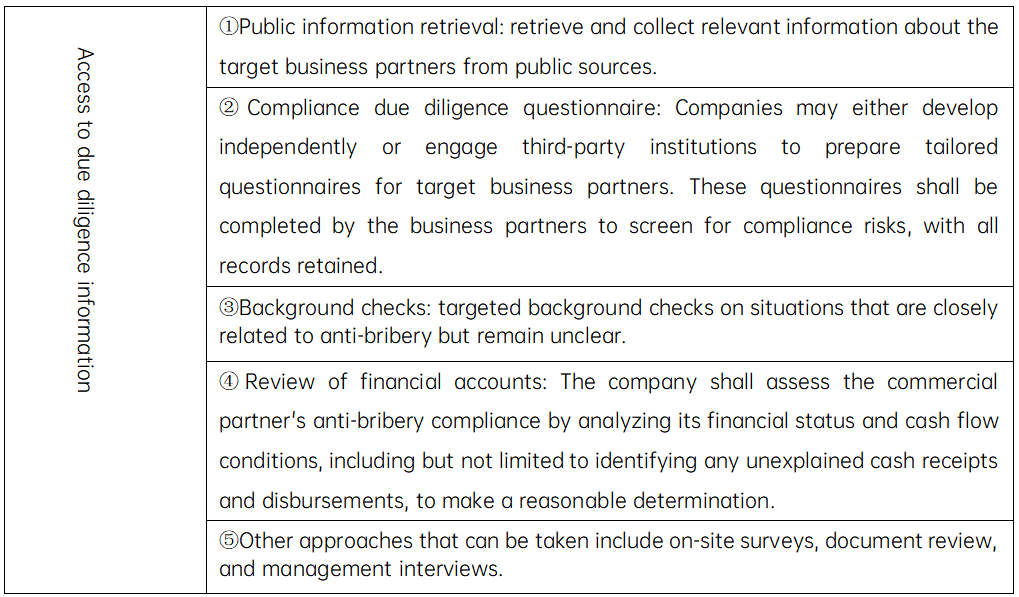
5.3.1.2 Key Focus Areas for Anti-Bribery Due Diligence
In the anti-bribery due diligence, the company shall focus on the following issues and request the target partner to confirm the written responses to the following questions and provide a commitment to ensure the authenticity of its responses:
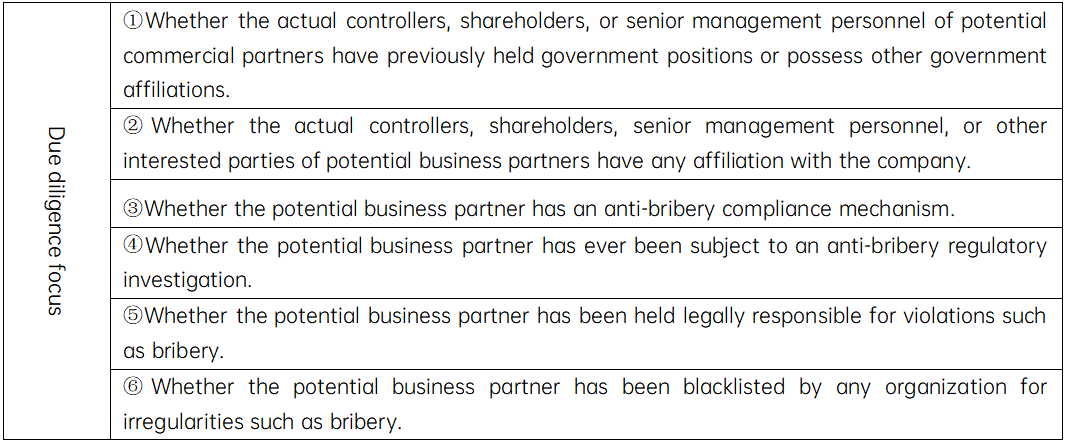
5.3.2 Equal Compliance Requirements for Business Partners
The company and all employees shall communicate the company's anti-bribery requirements to business partners and incorporate anti-bribery clauses into contracts with them, or require them to sign standalone anti-bribery agreements or provide anti-bribery commitment letters, ensuring business partners meet the following requirements:
(ⅰ) Adhere to the same anti-bribery compliance requirements as the Company;
(ⅱ) Not to offer or accept bribes of any kind;
(ⅲ)Maintain complete records of all expenses made in the company's name or on its behalf, and permit the company to access such records for audit purposes;
(ⅳ) Include bribery violations as one of the contract termination conditions, and explicitly specify the corresponding liability for breach of contract.
5.3.3 Continuous Monitoring System for Business Partners
Business partners shall be continuously monitored during contract performance. If they are found to have engaged in bribery, they shall cease to pay contractual fees or other payments to them in accordance with the contract, and shall be held liable for contractual breaches and other civil legal liabilities, and if they constitute a criminal offence, they shall also be referred to the criminal investigation authorities.
-
6 Anti-Bribery Management System
The company establishes its anti-bribery management system in accordance with ISO37001:2016 anti-bribery management standards and relevant laws and regulations in countries around the world.
6.1 Scope of application
This Manual applies to Zhejiang Huayou Cobalt Co., Ltd., all industrial groups, and subsidiaries. All employees are compliance obligors under this Manual.
6.2 Directions
Our company's anti-bribery management policy is "Compliance with Laws, Leadership Commitment, Full Participation, and Continuous Improvement."
Compliance with Laws: All company employees shall strictly adhere to relevant laws and regulations, international standards, and the provisions of this Manual in all activities.
Leadership Commitment: The company's governance bodies and management shall lead by example in implementing anti-bribery rules, foster a robust internal anti-bribery environment, integrate anti-bribery principles into corporate culture, and allocate adequate resources for anti-bribery management.
Company-wide Participation: All employees shall comply with laws and regulations, company policies, and anti-bribery management requirements, conduct themselves appropriately, and actively participate in corporate anti-bribery initiatives.
Continuous Improvement: The company shall persistently address and rectify obstacles and deficiencies affecting the implementation of anti-bribery management requirements throughout the compliance process.
6.3 Objectives
Establish anti-bribery management objectives at both corporate and functional department levels. The Audit and Supervision Center shall regularly monitor the achievement of these objectives and conduct continuous improvement initiatives.
6.4 Risk management
In accordance with the Anti-Bribery Risk Management Procedures, the company shall identify risks arising from internal/external environments, risks related to meeting stakeholders' needs and expectations, and bribery risks associated with functional departments' business activities. Identified bribery risks shall be categorized and managed by risk level.
6.5 Internal Audit
In compliance with the requirements of ISO 37001:2016 Anti-Bribery Management Systems, the company shall conduct an annual comprehensive internal audit covering all elements of the management system, with no more than 12 months between audits. The results of internal audits shall be reported to the Compliance Committee, Chief Compliance Officer, and the Anti-Bribery Compliance Department, with all relevant records retained.
Auditors shall be appointed by the Chief Compliance Officer and are prohibited from auditing work within their own functional departments.
6.6 Management Review
To ensure the sustained stability, appropriateness, and effective operation of the anti-bribery management system, the Compliance Committee shall conduct periodic reviews of the system.
The Compliance Management Committee shall consider when conducting a management review:
(ⅰ)Implementation status of measures proposed in previous management reviews;
(ⅱ) Changes in internal and external factors related to the anti-bribery management system;
(ⅲ) Information on the performance of the anti-bribery management system, including the following trends:
①Nonconformities and improvement measures;
②Monitoring and measurement results;
③Audit results;
④Bribery report;
⑤Findings;
⑥The nature and scope of the bribery risk to which the organization is exposed;
⑦The effectiveness of actions taken to address the risk of bribery;
⑧Opportunities for improvement of the anti-bribery management system.
The outputs of the Compliance Committee's review shall include decisions related to opportunities for continual improvement of the anti-bribery management system and needs for change.
-
Southeast/South/East China Business Department, New Energy Marketing Centre
Ternary Cathode Materials Industry (Domestic Markets)
-
Japan& Korea Business Department, New Energy Marketing Center
Ternary Cathode Materials Industry (Japanese &Korean Markets)
-
European& American Business Department, New Energy Marketing Center
Ternary Cathode Materials Industry (European& American Markets)
-
Operation Department, Recycling Industry Group
Domestic Waste Power Battery and Material Recycling Industry


